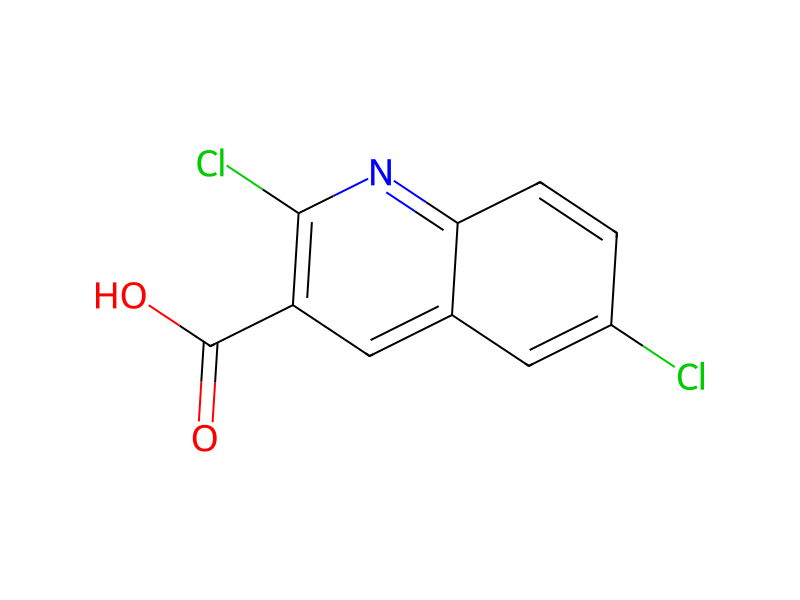
2,6-Dichloroquinoline-3-carboxylic acid → HCID 178524039, compound
Reaction equation

Cl[C:2]1[C:11]([C:12]([OH:14])=[O:13])=[CH:10][C:9]2[C:4](=[CH:5][CH:6]=[C:7]([Cl:15])[CH:8]=2)[N:3]=1.[NH2:16][C@@H:17]([CH2:26][C:27]1[CH:32]=[CH:31][CH:30]=[CH:29][CH:28]=1)[C:18]([NH:20][C:21]1[NH:25][N:24]=[N:23][N:22]=1)=[O:19]>CS(C)=O>[Cl:15][C:7]1[CH:8]=[C:9]2[C:4](=[CH:5][CH:6]=1)[N:3]=[C:2]([NH:16][C@H:17]([C:18](=[O:19])[NH:20][C:21]1[NH:25][N:24]=[N:23][N:22]=1)[CH2:26][C:27]1[CH:32]=[CH:31][CH:30]=[CH:29][CH:28]=1)[C:11]([C:12]([OH:14])=[O:13])=[CH:10]2Participants
4
Reactant 2

Product 1

Reagents, catalysts & solvents 1

Procedure
In close analogy to the procedure described in Example 1, 2,6-dichloroquinoline-3-carboxylic acid is reacted with (S)-2-amino-3-phenyl-N-(1H-tetrazol-5-yl)-propionamide (prepared by reaction of N-Boc-L-phenylalanine with isobutyl chloroformate followed by 5-amino-1H-tetrazole) in DMSO to provide the title compound in moderate yield.
Sources & evidence
- ORD record
- ord-a4bc8ab4791e4cfc856a2606216068ca
- Source dataset
- uspto-grants-2012_10
- Patent number
- US08288549B2
Reaction notes
Loading…