Sodium borohydride → (2-Chloro-4-morpholinothieno[3,2-d]pyrimidin-6-yl)methanol
Reaction equation

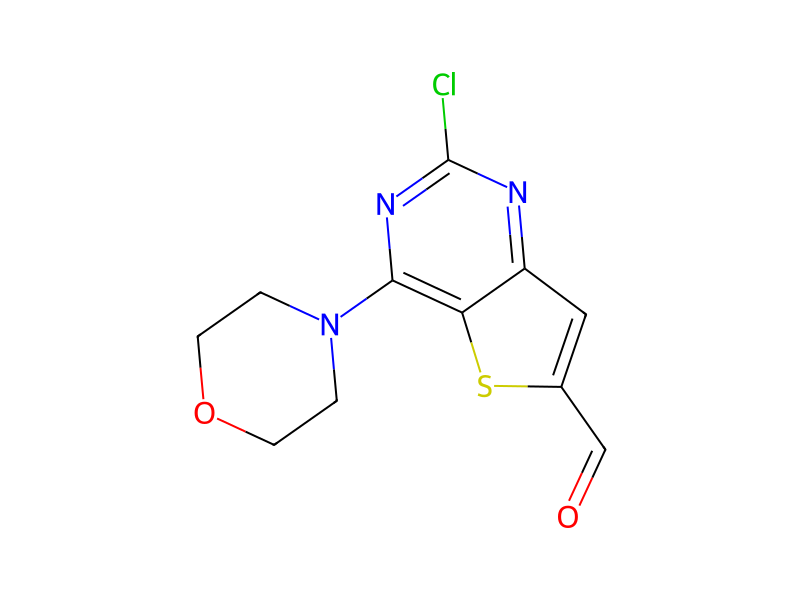
[Cl:1][C:2]1[N:3]=[C:4]([N:13]2[CH2:18][CH2:17][O:16][CH2:15][CH2:14]2)[C:5]2[S:10][C:9]([CH:11]=[O:12])=[CH:8][C:6]=2[N:7]=1.[BH4-].[Na+]>C1COCC1>[Cl:1][C:2]1[N:3]=[C:4]([N:13]2[CH2:14][CH2:15][O:16][CH2:17][CH2:18]2)[C:5]2[S:10][C:9]([CH2:11][OH:12])=[CH:8][C:6]=2[N:7]=1Participants
4



Procedure
To a suspension of 2-chloro-4-morpholin-4-yl-thieno[3,2-d]pyrimidine-6-carbaldehyde (3.2 g, 11.31 mmol) in anhydrous THF (100 mL) and IMS (70 mL) was added sodium borohydride (0.47 g, 12.42 mmol) and the resulting mixture stirred at RT for 2 h. The reaction mixture was partitioned between DCM and a saturated aqueous solution of NaHCO3. The organic layer was isolated, dried (MgSO4) and concentrated in vacuo. The resultant residue was triturated with water to give the title compound as a white solid (2.9 g, 91%).
Workup
- customThe reaction mixture was partitioned between DCM
- customThe organic layer was isolated
- dry with materialdried (MgSO4)
- concentrationconcentrated in vacuo
- customThe resultant residue was triturated with water
Sources & evidence
- ORD record
- ord-f82c51066f2145358bff5b8863e57db5
- Source dataset
- uspto-grants-2012_10
- Patent number
- US08293735B2
Reaction notes
Loading…