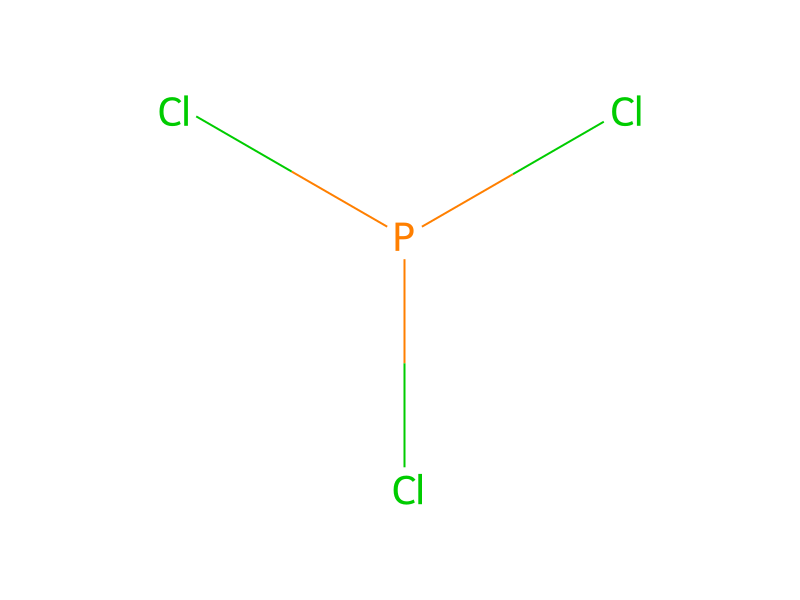
Phosphorus trichloride → HCID 178450588, compound
Reaction equation

[C-:1]1([C:6]([CH3:11])([CH3:10])[C:7](O)=[O:8])[CH:5]=[CH:4][CH:3]=[CH:2]1.[CH-:12]1[CH:16]=[CH:15][CH:14]=[CH:13]1.[Fe+2:17].P(Cl)(Cl)[Cl:19]>N1C=CC=CC=1.C1C=CC=CC=1>[C-:1]1([C:6]([CH3:11])([CH3:10])[C:7]([Cl:19])=[O:8])[CH:5]=[CH:4][CH:3]=[CH:2]1.[CH-:12]1[CH:16]=[CH:15][CH:14]=[CH:13]1.[Fe+2:17]Participants
Reactant 2

Product 1

Reagents, catalysts & solvents 2


Procedure
To a solution of 2-ferrocenyl-2-methylpropionic acid (7.55 g) and pyridine (15 drops) in 500 cm3 of dry benzene was slowly added 25 cm3 of phosphorous trichloride. The resulting mixture was stirred for 3 h at 60° to 70° C. After this time the solution was decanted off and the solvent removed under vacuum. The red-brown viscous residue obtained was twice more evaporated from dry benzene to give 6.91 g (85%) of 2-ferrocenyl-2-methylpropanoyl chloride, a red brown solid, which was recrystallised from light petroleum (40° to 60° C.). The ferrocenyl acid chloride (6.91 g) was dissolved in 10 cm3 of dichloromethane and added to a mixture of 6-aminopencillanic acid (5.18 g) and triethylamine (4.85 g) in 100 cm3 of dichloroethane at 2° C. The resulting mixture was stirred for 1 hour at 15° C., filtered and filtrate evaporated cold `in vacuo`. The residue was dissolved in a mixture of water and ethyl acetate and the aqueous phase adjusted to pH 2.5 with 2M HCl. The phases were separated and the aqueous phase extracted with ethyl acetate. The combined extracts of ethyl acetate were washed several times with water, dried and filtered. To the dry ethyl acetate solution was added 10 cm3 of a 40% solution of sodium 2-ethylhexanoate in 4-methylpentan-2-one. The mixture was concentrated under vacuum and then poured into 600 cm3 of dry ether. The product, which separated as a pale yellow solid, was collected by filtration and dried to yield 8.43 g (72%) of the penicillin. The i.r. spectrum showed a strong β-lactam carbonyl absorption at 1760 cm-1. A thin layer silica gel chromatogram (chloroform/acetone/acetic acid) showed a single substance.
Workup
- customAfter this time the solution was decanted off
- customthe solvent removed under vacuum
- customThe red-brown viscous residue obtained
- customwas twice more evaporated from dry benzene
Sources & evidence
- ORD record
- ord-5f69d34a399d4f5397aa26a03bfd2b4c
- Source dataset
- uspto-grants-1977_09
- Patent number
- US04046903
Reaction notes
Loading…