Maleic Anhydride → 3-(Tributyl-lambda~5~-phosphanylidene)oxolane-2,5-dione
Reaction equation

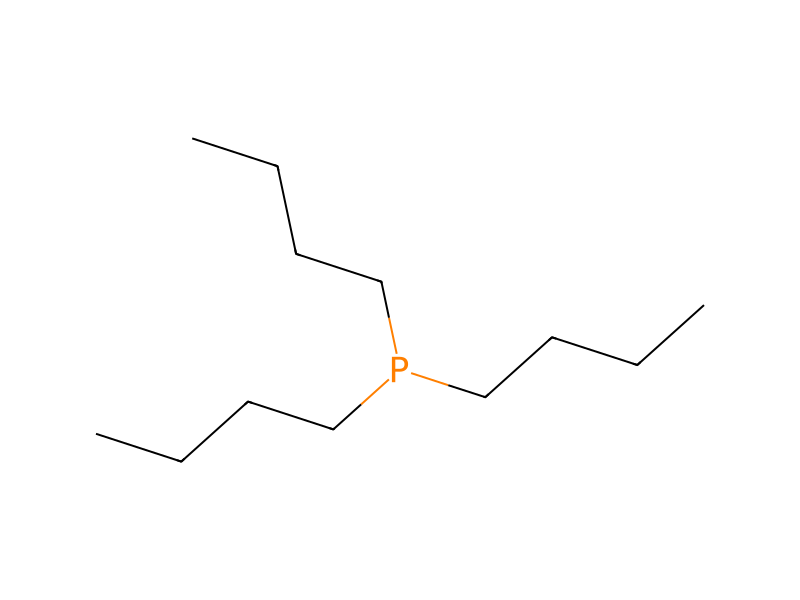
[C:1]1(=[O:7])[O:6][C:4](=[O:5])[CH:3]=[CH:2]1.[CH2:8]([P:12]([CH2:17][CH2:18][CH2:19][CH3:20])[CH2:13][CH2:14][CH2:15][CH3:16])[CH2:9][CH2:10][CH3:11]>CC(C)=O>[CH2:17]([P:12]([CH2:8][CH2:9][CH2:10][CH3:11])([CH2:13][CH2:14][CH2:15][CH3:16])=[C:2]1[CH2:3][C:4](=[O:5])[O:6][C:1]1=[O:7])[CH2:18][CH2:19][CH3:20]Participants
4
Reactant 2

Product 1

Reagents, catalysts & solvents 1

Procedure
Maleic anhydride (9.81 g; 0.1 mole) in 25 ml acetone and tri-n-butylphosphine (20.23 g; 0.1 mole) in acetone were blended at 0°-5° C under a blanket of dry nitrogen. The resulting red solution was stirred for 1 hour at room temperature and then placed under vacuum to remove the bulk of the acetone solvent. The resulting red viscous liquid gave 15 g of yellow-brown crystalline product. This solid was separated by filtration and washed with cold acetone giving a yellow crystalline product which melts at 70° C, resolidifies and melts again at 85° C with gassing. The infrared (IR) and nuclear magnetic resonance (NMR) spectra and elemental analysis of the product were consistent with a compound represented by the structure ##STR8##
Workup
- customwere blended at 0°-5° C under a blanket of dry nitrogen
- customto remove the bulk of the acetone solvent
Sources & evidence
- ORD record
- ord-2a9f9f3952444f01a966a8cddbc67f84
- Source dataset
- uspto-grants-1977_09
- Patent number
- US04048141
Reaction notes
Loading…