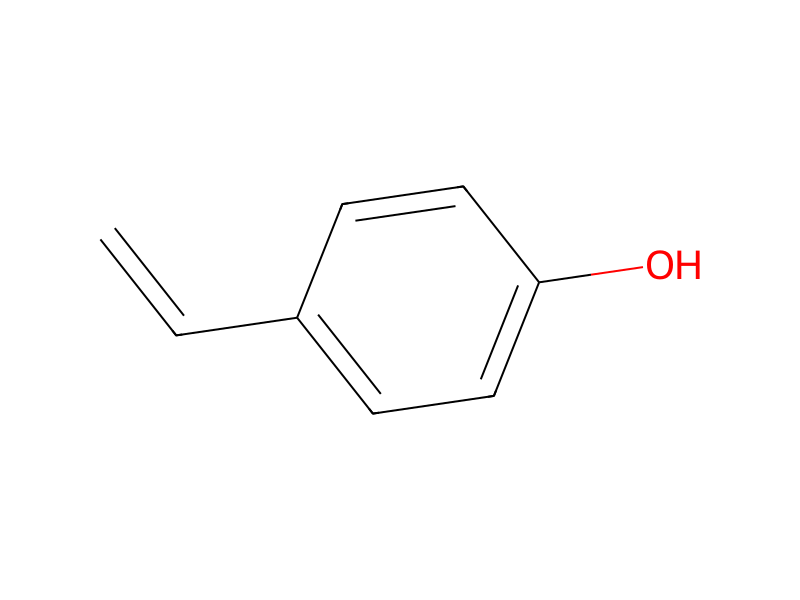
Carbon Dioxide → 4-Vinylphenol
Reaction equation

[OH:1][C:2]1[CH:12]=[CH:11][C:5]([CH:6]=[CH:7]C(O)=O)=[CH:4][CH:3]=1.N1C2C(=CC=CC=2)C=CC=1.C1(C=CC(O)=CC=1)O.C(=O)=O>[Cu]>[CH:6]([C:5]1[CH:11]=[CH:12][C:2]([OH:1])=[CH:3][CH:4]=1)=[CH2:7]Participants
Reactant 4




Product 1
Reagents, catalysts & solvents 1

Procedure
Para-vinylphenol was prepared as follows. 15.6 g of p-hydroxycinnamic acid were mixed to a slurry with 15 ml quinoline, 0.6 g copper turnings and 1.1 g hydroquinone. The mixture was heated by an oil bath at 200° C. for 15 minutes after which time the evolution of CO2 had almost ceased. The reaction mixture was then cooled and distilled under rotary pump vacuum, the fraction collected between 60° and 80° C. being p-vinylphenol and quinoline. (Bpt. Quinoline=114° C./15 mm Hg; p-vinylphenol=115° C./16 mm Hg). The distilled fraction was taken up into warm diethyl ether, the solution neutralised by successive washing of N HCl and distilled water and then dried by MgSO4. After removal of the solvent, the residue was redissolved by warm petroleum ether (40°-60° C.). On cooling 1.36 g of colourless, platey crystals were obtained. Yield=11.76%. These were recrystallised from the same solvent prior to copolymerisation.
Workup
- temperatureThe reaction mixture was then cooled
- distillationdistilled under rotary pump vacuum
- customthe fraction collected between 60° and 80° C.
- custom(Bpt. Quinoline=114° C./15 mm Hg; p-vinylphenol=115° C./16 mm Hg)
- temperatureinto warm diethyl ether
- washby successive washing of N HCl
- distillationdistilled water
- dry with materialdried by MgSO4
- customAfter removal of the solvent
- dissolutionthe residue was redissolved
- temperatureby warm petroleum ether (40°-60° C.)
- temperatureOn cooling 1.36 g of colourless, platey crystals
- customwere obtained
- customThese were recrystallised from the same solvent
- customto copolymerisation
Sources & evidence
- ORD record
- ord-db02ef3607d44327b461af74094675c5
- Source dataset
- uspto-grants-1990_04
- Patent number
- US04920092
Reaction notes
Loading…