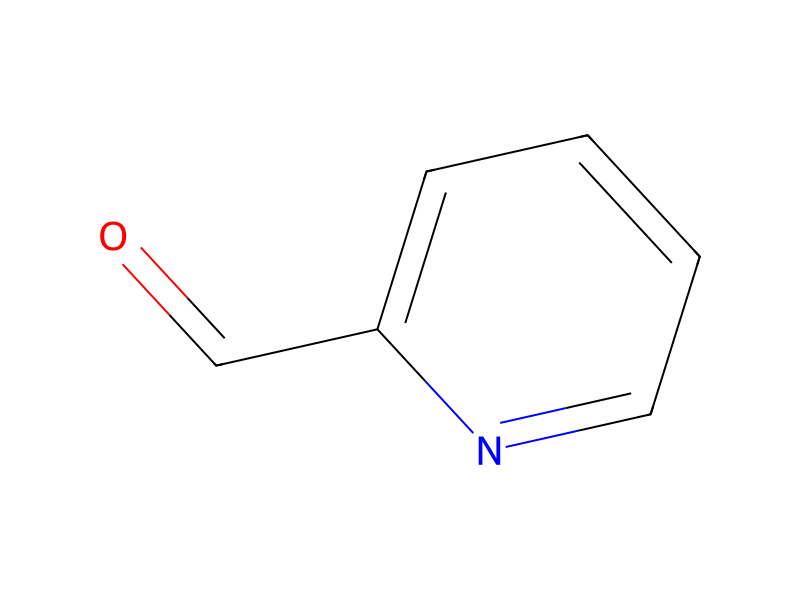
2-Pyridinecarboxaldehyde → 7-Iodo-1-pyridin-2-yl-[1,2,4]triazolo[4,3-a]quinoline
Reaction equation

[I:1][C:2]1[CH:3]=[C:4]2[C:9](=[CH:10][CH:11]=1)[N:8]=[C:7]([NH:12][NH2:13])[CH:6]=[CH:5]2.[N:14]1[CH:19]=[CH:18][CH:17]=[CH:16][C:15]=1[CH:20]=O.C(O)(=O)C.C(O)(=O)C.IC1C=CC=CC=1>C(Cl)Cl>[I:1][C:2]1[CH:3]=[C:4]2[C:9](=[CH:10][CH:11]=1)[N:8]1[C:20]([C:15]3[CH:16]=[CH:17][CH:18]=[CH:19][N:14]=3)=[N:13][N:12]=[C:7]1[CH:6]=[CH:5]2Participants
5



Procedure
To (6-Iodo-quinolin-2-yl)-hydrazine (2.99 g, 10.5 mmol) suspended in CH2Cl2 (30 mL) was added 2-pyridinecarboxaldehyde (1.2 mL, 12.6 mmol). The reaction was stirred at room temperature for 2 hours, followed by the addition of iodobenzene diacetate (3.39 g, 10.5 mmol). The reaction was stirred overnight at room temperature, during which time a precipitate formed. The mixture was concentrated to half the volume, and the precipitate was filtered and washed with minimal CH2Cl2 to give the desired product, 5k. The filtrate was concentrated and suspended in EtOH. After stirring overnight at room temperature, the mixture was filtered and rinsed with EtOH to obtain additional product, 5k.
Workup
- stirringThe reaction was stirred overnight at room temperature, during which time a precipitate
- customformed
- concentrationThe mixture was concentrated to half the volume
- filtrationthe precipitate was filtered
- washwashed with minimal CH2Cl2
Sources & evidence
- ORD record
- ord-0de7e5fe627a46139bccc5c89a4503f6
- Source dataset
- uspto-grants-2011_04
- Patent number
- US07919621B2
Reaction notes
Loading…