Malic Acid → D-Malic acid
Reaction equation

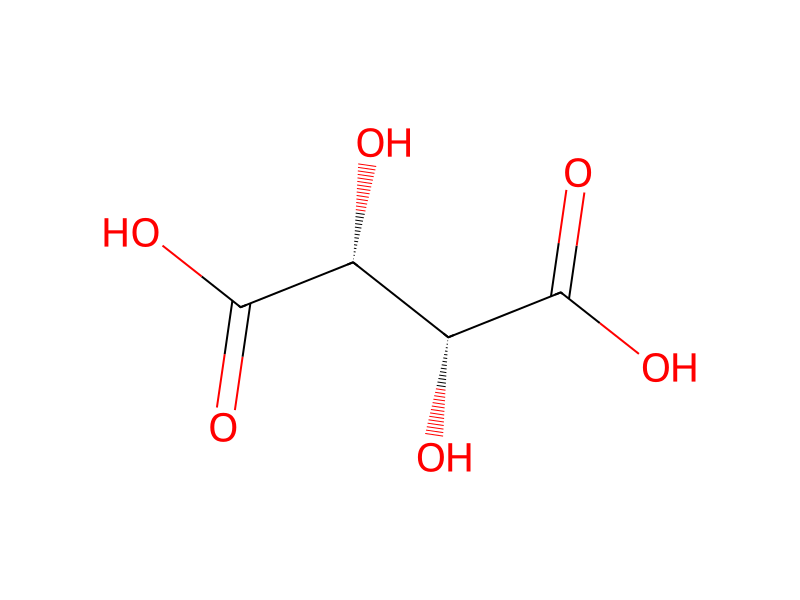
[C:1]([OH:10])(=[O:9])[CH:2]([CH:4]([C:6]([OH:8])=[O:7])[OH:5])[OH:3].[C:11]([OH:19])(=[O:18])[CH:12]([CH2:14][C:15]([OH:17])=[O:16])[OH:13]>>[C:1]([OH:10])(=[O:9])[C@@H:2]([C@H:4]([C:6]([OH:8])=[O:7])[OH:5])[OH:3].[C:11]([OH:19])(=[O:18])[C@@H:12]([CH2:14][C:15]([OH:17])=[O:16])[OH:13]Participants


Procedure
Because of its abundance, tartaric acid, especially the natural L-isomer, has been widely used for the preparation of optically pure malic acid and its derivatives. From the naturally-occurring L-tartaric acid, the unnatural D-malic acid is produced. For examples, Hungerbuhler et al., (Angew. Chem. Int. Ed. Engl. 1979, 18, 958) prepared D-dimethyl malate from L-dimethyl tartrate via the reduction of the corresponding β-bromo malate by tributyltin hydride in four steps and 44% yield. Alpegiani et al., (J. Org. Chem. 1987, 52, 278) obtained D-dimethyl malate from L-dimethyl tartrate via the reduction of the corresponding thionocarbonate derivative by tributyltin hydride in two steps and 67% yield. Gao et al., (J. Am. Chem. Soc. 1988, 110, 7538) have developed a general method for the preparation of D-malate from L-tartrate via the reduction of the corresponding tartrate cyclic sulfate by sodium cyanoborohydride. For example, D-diisopropyl malate is prepared in 50% overall yield from L-diisopropyl tartrate. More recently Kusuda et al., (Tetrahedron Lett. 1989, 30, 2945) prepared D-diisopropyl malate from L-(+)-diisopropyl tartrate directly by the reduction of the latter with samarium iodide in 99% yield. However, methods described above involve the use of expensive and hazardous reagents for the preparation of the intermediates and in subsequent reductions. Therefore, they are not amenable to the large-scale production of optically pure malic acid and its derivatives.
Sources & evidence
- ORD record
- ord-c6da04c3c19e4859b531e0f40996a990
- Source dataset
- uspto-grants-1993_02
- Patent number
- US05189200
Reaction notes
Loading…