Methacrylic Acid → Methacrylic Acid
Reaction equation

[C:1]([OH:6])(=[O:5])[C:2]([CH3:4])=[CH2:3].[C:7]([O:11][CH2:12][CH2:13][CH2:14][CH3:15])(=[O:10])[CH:8]=[CH2:9]>O>[C:7]([O:11][CH2:12][CH2:13][CH2:14][CH3:15])(=[O:10])[CH:8]=[CH2:9].[C:1]([O:6][CH3:7])(=[O:5])[C:2]([CH3:4])=[CH2:3].[C:1]([OH:6])(=[O:5])[C:2]([CH3:4])=[CH2:3]Participants
Reactant 2

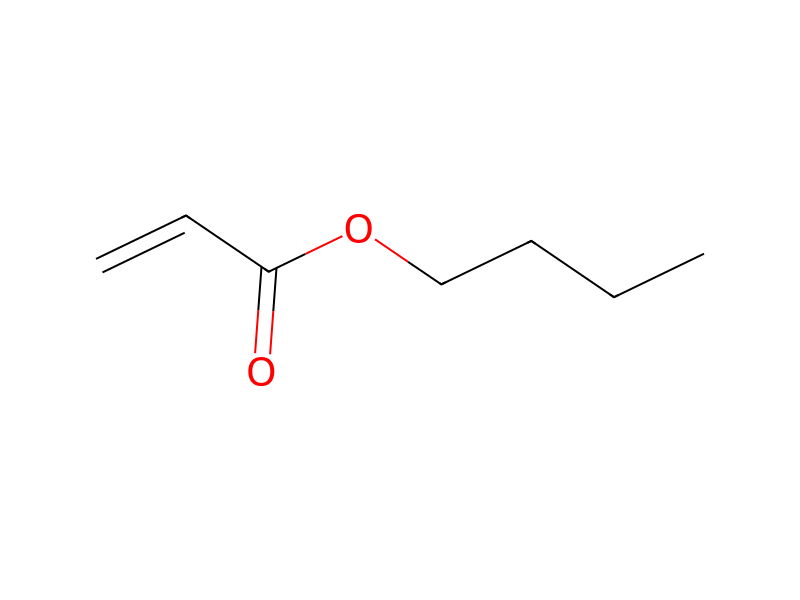
Product 3

Reagents, catalysts & solvents 1

Conditions
- Temperature
- 81 °C
Procedure
A sample of butyl acrylate (BA), methyl methacrylate (MA), and methacrylic acid (MAA) polymer was prepared according to the procedure in Comparative Example 1 except that the monomer mixture consisted of 28.1 g MAA, 1915.9 g MMA, 216.0 g BA and 10.5 g SLS. In this case, a reaction vessel containing 1130 g deionized, buffered water and 4.0 g SLS was heated to 81° C. The remaining monomer mix, NaPS, as well as an additional 16.5 g of SLS were fed to the vessel after the initial addition of the mixture. Following neutralization, the resultant polymer had an average particle size of 317 nm with a particle size distribution ranging from 174 nm to 408 nm. The calculated Tg of this polymer was 70° C. In an assessment of printability, an ink containing 3.0% of this polymer was found to have acceptable performance in terms of low number of missing nozzles after 90 pages, but unacceptable performance in terms of wet-rub smear or resistance to smearing by highlighter pens.
Workup
- additionIn this case, a reaction vessel containing 1130 g
- additionThe remaining monomer mix
- additionaddition of the mixture
- customwas 70° C
Sources & evidence
- ORD record
- ord-93bcea37b6b14c439b20c8a735538eaf
- Source dataset
- uspto-grants-2004_04
- Patent number
- US06716912B2
Reaction notes
Loading…