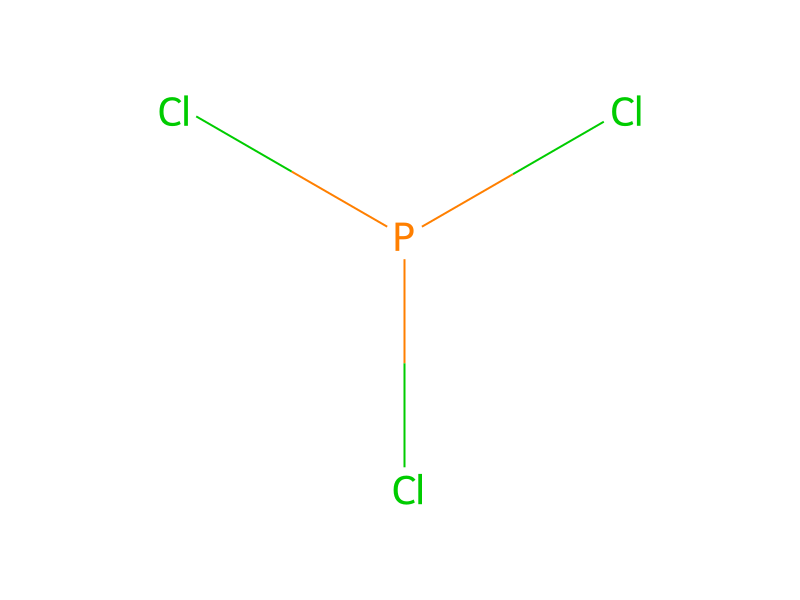
Phosphorus trichloride → HCID 21305556, compound
Reaction equation

[P:1]([Cl:4])(Cl)[Cl:2].[CH3:5][CH:6]1[CH2:10][CH2:9][CH:8]([CH3:11])[N:7]1[C:12]1[CH:17]=[CH:16][C:15]([CH3:18])=[CH:14][CH:13]=1>N1C=CC=CC=1>[CH3:5][CH:6]1[CH2:10][CH2:9][CH:8]([CH3:11])[N:7]1[C:12]1[CH:13]=[CH:14][C:15]([CH3:18])=[CH:16][C:17]=1[P:1]([Cl:4])[Cl:2]Participants
Reactant 2

Product 1

Reagents, catalysts & solvents 1

Procedure
A solution of PCl3 (36.3 g, 264.3 mm) in 200 mL of pyridine was treated with (+/−)-2,5-dimethyl-1-N(4′-methylphenyl)pyrrolidine (10.0 g, 52.8 mm) over a period of 5 min. The resulting mixture was then refluxed for 2 days to give the crude (+/−)-2,5-dimethyl-1-N(2′-dichlorophosphino-4′-methylphenyl)pyrrolidine (31P NMR: δ164.7 (s), 159.9 (s) ppm). After precipitates (Py.HCl) were filtered off, the excess PCl3 and pyridine solvent were removed from filtrates, a mixture of 100 mL of pyridine and 300 mL of THF was added to the resulting residue. Next, polymer-supported secondary amines (15.0 g, 1.1 mmol/g, 16.5 mmol) was slowly added into the mixture above while stirring at room temperature for a period of 10 min. The resulting suspension was refluxed overnight before the solution was filtered off. The resin was washed with THF (2×50 mL), hexane (3×50 mL), CH2Cl2 (4×50 mL), and hexane (2×50 mL). The resulting resin was dried in vacuum overnight to yield the polymer-supported (+/−)-2,5-dimethyl-1-N(1-N(2′-chlorophosphino-4′-methylphenyl)pyrrolidine. 31P NMR (122 MHz, CDCl3): δ145.1, 136.0 ppm.
Workup
- temperatureThe resulting mixture was then refluxed for 2 days
Sources & evidence
- ORD record
- ord-ff0bd9ba1e7049bba0f0f72c0a42263d
- Source dataset
- uspto-grants-2004_04
- Patent number
- US06716984B2
Reaction notes
Loading…