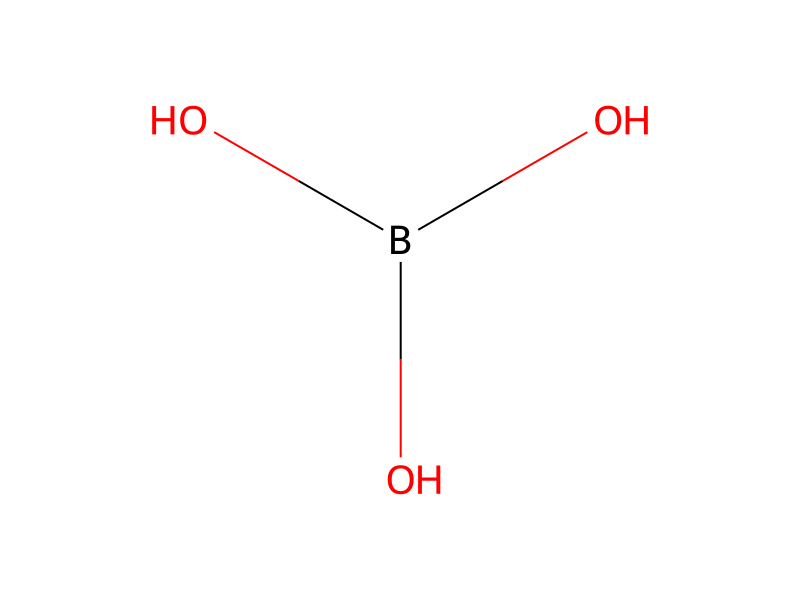
Boric Acid → HCID 59014071, compound
Reaction equation

N1C=CC=NC=1.CC1C=NC=CC=1C(NC1C=CC([C:19]2[S:20][C:21]([C:25]3[CH:26]=[N:27][CH:28]=[N:29][CH:30]=3)=[CH:22][C:23]=2[CH3:24])=CC=1)=O.B(O)(O)O.S1C=CC=C1.BrC1C=CC=NC=1>[Pd]>[N:29]1[CH:30]=[C:25]([C:21]2[S:20][CH:19]=[C:23]([CH3:24])[CH:22]=2)[CH:26]=[N:27][CH:28]=1Participants
Reactant 5




Product 1

Reagents, catalysts & solvents 1

Procedure
The pyrimidine substituent on the thiophene ring of 3-Methyl-N-[4-(3-methyl-5-pyrimidin-5-yl-thiophen-2-yl)-phenyl]-isonicotinamide was attached using a Suzuki coupling reaction (as describe in Step B of the synthesis of compound 1) by reacting a boric acid derivative of thiophene (o) with 5-bromo-pyridine (p) in the presence of a palladium catalyst to form 2-(pyrimidin-5-yl)-4-methyl-thiophene (q). In general, aromatic substituents such as pyridine, can be added to thiophene, oxazole, thiazole and oxazole ring systems by using a Suzuki coupling reaction. A bromo substituent was added to (q) by reacting it with N-bromo-succinimide in acetic acid to form 2-(pyrimidin-5-yl)-4-methyl-5-bromo-thiophene (r). Compound (r) is then coupled to an amino pyridine using a Suzuki coupling reaction (as describe in Step B of the synthesis of compound 1) to form Compound (s). Compound (s) is then reacted with 2-methyl-isonicotinoyl chloride in a reaction analogous to the reaction described in step A of the synthesis of 4-[4-(2,6-Difluoro-benzoylamino)-phenyl]-5-methyl-thiophene-2-carboxylic acid methyl ester to form 3-Methyl-N-[4-(3-methyl-5-pyrimidin-5-yl-thiophen-2-yl)-phenyl]-isonicotinamide.
Workup
- customa Suzuki coupling reaction (
Sources & evidence
- ORD record
- ord-29e224edb30f47e189cf6640200b515b
- Source dataset
- uspto-grants-2013_05
- Patent number
- US08435996B2
Reaction notes
Loading…