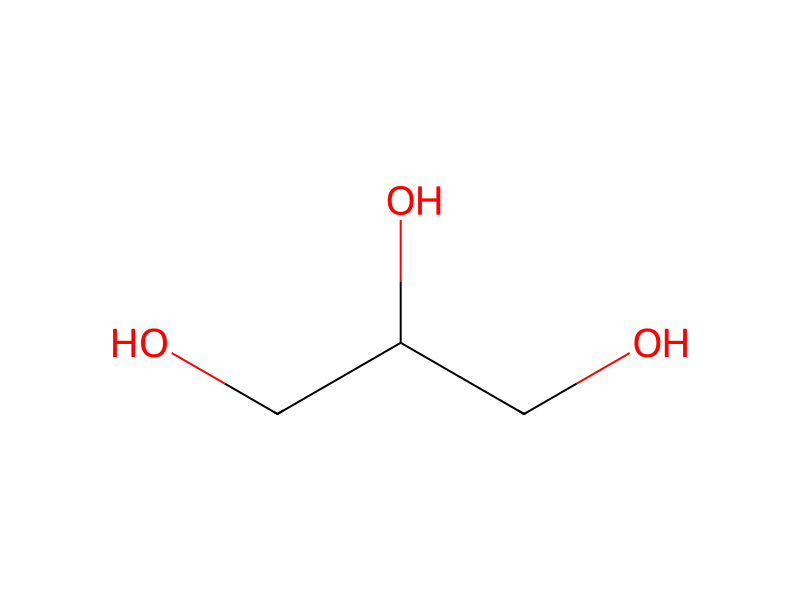
Glycerol → 5-Bromo-8-fluoroquinoline
Reaction equation

[Br:1][C:2]1[CH:3]=[CH:4][C:5]([F:9])=[C:6]([CH:8]=1)[NH2:7].O[CH2:11][CH:12]([CH2:14]O)O.[N+](C1C=C(S([O-])(=O)=O)C=CC=1)([O-])=O.[Na+].S(=O)(=O)(O)O>[OH-].[Na+]>[Br:1][C:2]1[CH:3]=[CH:4][C:5]([F:9])=[C:6]2[C:8]=1[CH:11]=[CH:12][CH:14]=[N:7]2Participants
Reactant 4



Product 1

Reagents, catalysts & solvents 1

Conditions
- Temperature
- 140 °C
Procedure
5-Bromo-2-fluoroaniline (1.0 g, 5.3 mmol) was mixed with glycerol (2.0 mL, 27 mmol), sodium 3-nitrobenzene sulfonate (1.2 g, 5.3 mmol) and concentrated sulfuric acid (8 mL), then the mixture was heated to 140° C. for 2 hours. The inital suspension became a dark brown solution. The mixture was allowed to cool to room temperature. The solution was made basic with 5N NaOH (30 mL), then extracted with EtOAc. The combined organic phase was washed with water then saturated NaCl (aq), dried over MgSO4, filtered, then concentrated to afford the title compound as a white solid. 1H NMR (500 MHz, CDCl3): δ 9.00 (d, J=4.2 Hz, H); 8.54 (d, J=8.6 Hz, 1H); 7.77 (dd, J=8.3, 4.5 Hz, 1H); 7.59 (dd, J=8.6, 4.2 Hz, 1H); 7.32 (dd, J=9.9, 8.3 Hz, 1H). LC4 1.81 min. (M+H)=226.
Workup
- temperatureto cool to room temperature
- extractionextracted with EtOAc
- washThe combined organic phase was washed with water
- dry with materialsaturated NaCl (aq), dried over MgSO4
- filtrationfiltered
- concentrationconcentrated
Sources & evidence
- ORD record
- ord-46ac6b14af704312aeb903aa8cc8b99b
- Source dataset
- uspto-grants-2013_05
- Patent number
- US08436015B2
Reaction notes
Loading…