Acetic Acid → Benzonitrile, 3-bromo-4-hydroxy-5-nitro-
Reaction equation

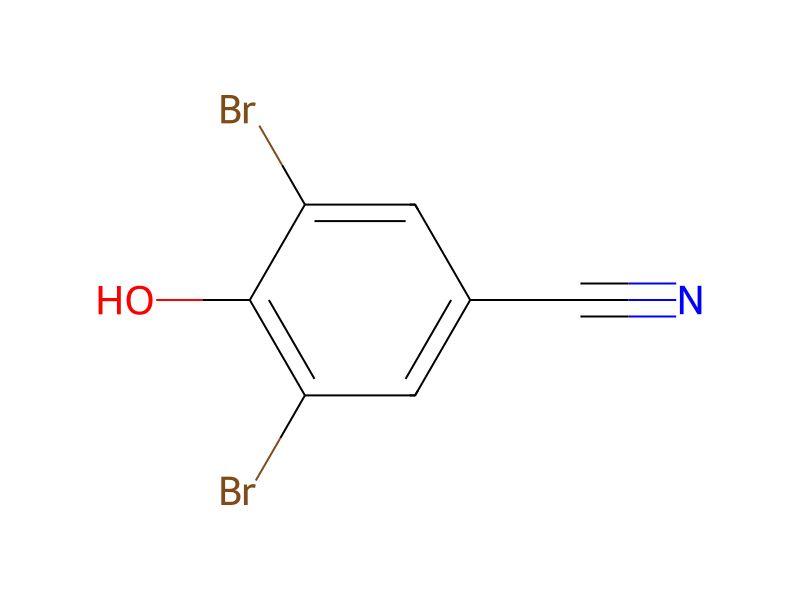
[Br:1][C:2]1[CH:3]=[C:4]([CH:7]=[C:8](Br)[C:9]=1[OH:10])[C:5]#[N:6].C(O)(=O)C.[N:16]([O-:18])=[O:17].[Na+].O>C(OCC)(=O)C>[Br:1][C:2]1[CH:3]=[C:4]([CH:7]=[C:8]([N+:16]([O-:18])=[O:17])[C:9]=1[OH:10])[C:5]#[N:6]Participants
6
Reactant 4



Product 1

Reagents, catalysts & solvents 1

Conditions
- Temperature
- 50 °C
Procedure
To a 5-L, 3-neck round-bottom flask fitted with a thermocouple, stirring paddle, and nitrogen line were added 3,5-dibromo-4-hydroxybenzonitrile (95 g) and glacial acetic acid (3.3 L). Sodium nitrite (120 g) was then added in small portions. The mixture was heated to 50° C. and stirred overnight at this temperature. The mixture was then allowed to cool and poured into a large extractor containing water (10 L). Ethyl acetate (10 L) was added and the layers were separated. The aqueous layer was extracted with ethyl acetate (4 L) and the combined organic layers were washed with water and brine, and then dried over magnesium sulfate and concentrated in vacuo to provide 96.9 g of the desired product. Mass spectrum (ESI) 243.0 (M+).
Workup
- stirringstirred overnight at this temperature
- temperatureto cool
- additionpoured into a large extractor
- customthe layers were separated
- extractionThe aqueous layer was extracted with ethyl acetate (4 L)
- washthe combined organic layers were washed with water and brine
- dry with materialdried over magnesium sulfate
- concentrationconcentrated in vacuo
Sources & evidence
- ORD record
- ord-5ae6ebe2edf1447c92ac869e4dc9305e
- Source dataset
- uspto-grants-2013_05
- Patent number
- US08436028B2
Reaction notes
Loading…