1,4-Dioxane → 2-(4-{2-[2-amino-6-(4-methylpiperazin-1-yl)pyrimidin-4-yl]-3-methyl-1,2,3,4-tetrahydroisoquinolin-7-yl}-1H-pyrazol-1-yl)ethanol
Reaction equation

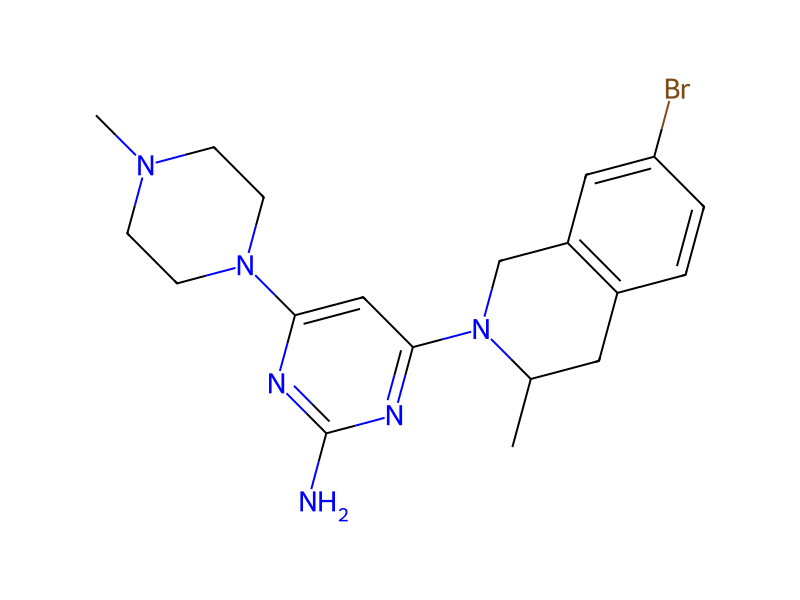
Br[C:2]1[CH:11]=[C:10]2[C:5]([CH2:6][CH:7]([CH3:26])[N:8]([C:12]3[CH:17]=[C:16]([N:18]4[CH2:23][CH2:22][N:21]([CH3:24])[CH2:20][CH2:19]4)[N:15]=[C:14]([NH2:25])[N:13]=3)[CH2:9]2)=[CH:4][CH:3]=1.[Si]([O:34][CH2:35][CH2:36][N:37]1[CH:41]=[C:40](B2OC(C)(C)C(C)(C)O2)[CH:39]=[N:38]1)(C(C)(C)C)(C)C.C(=O)(O)[O-].[Na+].O1CCOCC1>C1C=CC([P]([Pd]([P](C2C=CC=CC=2)(C2C=CC=CC=2)C2C=CC=CC=2)([P](C2C=CC=CC=2)(C2C=CC=CC=2)C2C=CC=CC=2)[P](C2C=CC=CC=2)(C2C=CC=CC=2)C2C=CC=CC=2)(C2C=CC=CC=2)C2C=CC=CC=2)=CC=1.O>[NH2:25][C:14]1[N:13]=[C:12]([N:8]2[CH:7]([CH3:26])[CH2:6][C:5]3[C:10](=[CH:11][C:2]([C:40]4[CH:39]=[N:38][N:37]([CH2:36][CH2:35][OH:34])[CH:41]=4)=[CH:3][CH:4]=3)[CH2:9]2)[CH:17]=[C:16]([N:18]2[CH2:19][CH2:20][N:21]([CH3:24])[CH2:22][CH2:23]2)[N:15]=1Participants
Reactant 4



Product 1

Reagents, catalysts & solvents 2


Conditions
- Temperature
- 90 °C
Procedure
A mixture of 4-(7-bromo-3-methyl-3,4-dihydroisoquinolin-2(1H)-yl)-6-(4-methylpiperazin-1-yl)pyrimidin-2-amine (10 mg, 0.02 mmol; Peak 1, Example 49, Step 7), 1-(2-{[tert-butyl(dimethyl)silyl]oxy}ethyl)-4-(4,4,5,5-tetramethyl-1,3,2-dioxaborolan-2-yl)-1H-pyrazole (10 mg, 0.029 mmol), tetrakis(triphenylphosphine)palladium(0) (1.4 mg, 0.0012 mmol), sodium bicarbonate (6.0 mg, 0.072 mmol) in a solution of 1,4-dioxane (0.2 mL) and water (0.1 mL) in a reaction vial was stirred at 90° C. overnight. After cooling it was concentrated. The residue was treated with methanol. The solid was filtered off. The filtrate was concentrated. The resulting residue was dissolved in 1.5 ml of 1% HCl ethanol solution, and stirred at r.t. overnight. Then it was purified with RP-HPLC (pH=10) to afford the desired product (4.6 mg). LCMS (M+H)+: m/z=449.3.
Workup
- temperatureAfter cooling it
- concentrationwas concentrated
- additionThe residue was treated with methanol
- filtrationThe solid was filtered off
- concentrationThe filtrate was concentrated
- dissolutionThe resulting residue was dissolved in 1.5 ml of 1% HCl ethanol solution
- stirringstirred at r.t. overnight
- customThen it was purified with RP-HPLC (pH=10)
Sources & evidence
- ORD record
- ord-68da9cf126c14ec0a8483f3d43fb4e7c
- Source dataset
- uspto-grants-2013_05
- Patent number
- US08436008B2
Reaction notes
Loading…