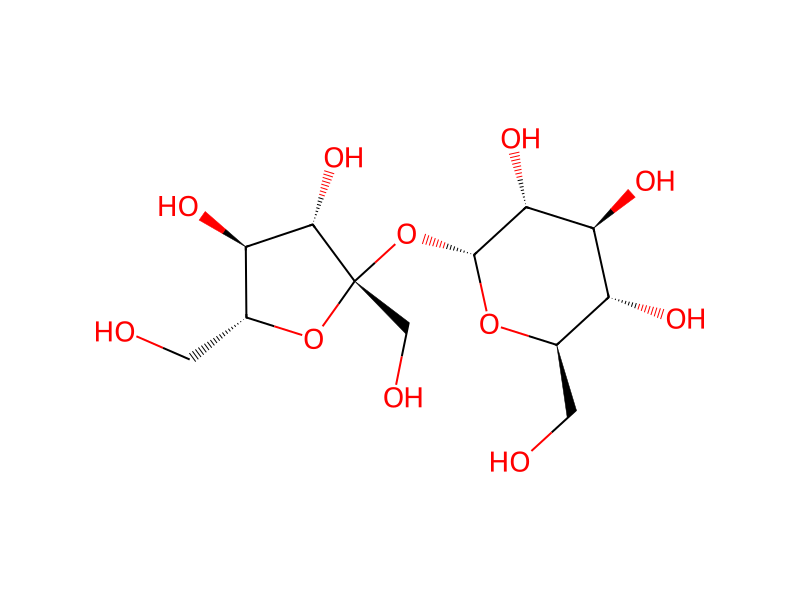
Sucrose → 1-Benzyl 3-ethyl 4-hydroxypyrrolidine-1,3-dicarboxylate
Reaction equation

C(O)[C@H]1O[C@H](O[C@]2(CO)O[C@H](CO)[C@@H](O)[C@@H]2O)[C@H](O)[C@@H](O)[C@@H]1O.[CH2:24]([O:26][C:27]([CH:29]1[C:33](=[O:34])[CH2:32][N:31]([C:35]([O:37][CH2:38][C:39]2[CH:44]=[CH:43][CH:42]=[CH:41][CH:40]=2)=[O:36])[CH2:30]1)=[O:28])[CH3:25]>O>[CH2:24]([O:26][C:27]([CH:29]1[CH:33]([OH:34])[CH2:32][N:31]([C:35]([O:37][CH2:38][C:39]2[CH:40]=[CH:41][CH:42]=[CH:43][CH:44]=2)=[O:36])[CH2:30]1)=[O:28])[CH3:25]Participants
Reactant 2

Product 1

Reagents, catalysts & solvents 1

Conditions
- Temperature
- 32 °C
Procedure
To a solution of sucrose (3 g) in distilled water (40 mL) was added Baker's yeast (2 g). The suspension was heated at 32° C. for 1 h. The content of the flask was then poured into a flask containing ketoester 71 (2.9 g, 9.88 mmol, dissolved in 4 mL of methanol). Stirring was continued at 32° C. for 24 h after which additional sucrose (3 g) in warm (40° C.) distilled water was added. After 48 h, the suspension was filtered through a pad of Celite. The pad was washed with water and the aqueous layer was extracted with ethyl acetate (3×250 mL). The combined organic layer was dried over anhydrous sodium sulfate, filtered and concentrated under reduced pressure. The residue was subjected to flash chromatography (30% EtOAc/Hexane) to afford alcohol 73 (1.2 g, 41%).
Workup
- additionThe content of the flask was then poured into a flask
- distillationdistilled water
- additionwas added
- waitAfter 48 h
- filtrationthe suspension was filtered through a pad of Celite
- washThe pad was washed with water
- extractionthe aqueous layer was extracted with ethyl acetate (3×250 mL)
- dry with materialThe combined organic layer was dried over anhydrous sodium sulfate
- filtrationfiltered
- concentrationconcentrated under reduced pressure
Sources & evidence
- ORD record
- ord-f664404877054a14b5f42649bcf16bdc
- Source dataset
- uspto-grants-2010_06
- Patent number
- US07745608B2
Reaction notes
Loading…