Acetone → 1-Benzyl-N-isopropylpiperidin-4-amine
Reaction equation

[NH2:1][CH:2]1[CH2:7][CH2:6][N:5]([CH2:8][C:9]2[CH:14]=[CH:13][CH:12]=[CH:11][CH:10]=2)[CH2:4][CH2:3]1.[CH3:15][C:16]([CH3:18])=O.C(O[BH-](OC(=O)C)OC(=O)C)(=O)C.[Na+]>ClCCl>[CH2:8]([N:5]1[CH2:6][CH2:7][CH:2]([NH:1][CH:16]([CH3:18])[CH3:15])[CH2:3][CH2:4]1)[C:9]1[CH:14]=[CH:13][CH:12]=[CH:11][CH:10]=1Participants
Reactant 3

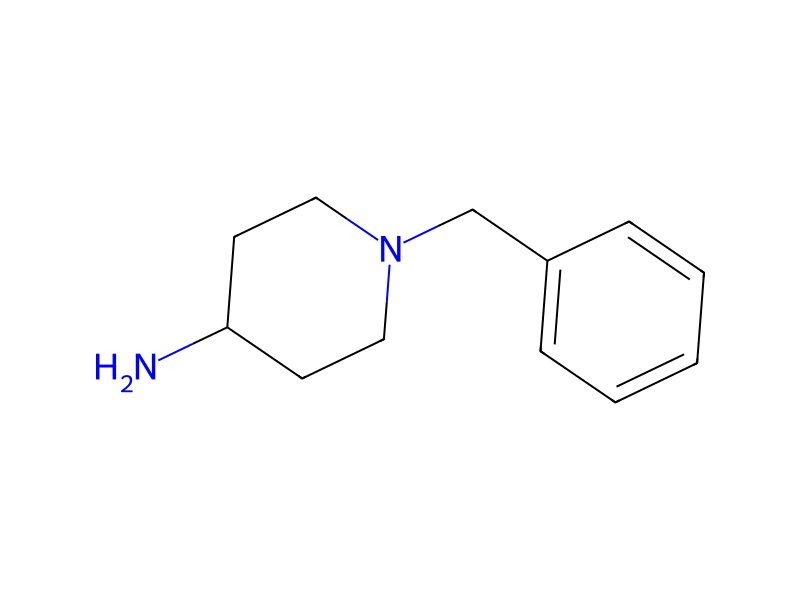

Product 1

Reagents, catalysts & solvents 1

Procedure
To a 50 L 3-neck round-bottom reaction flask equipped with a mechanical stirrer, temperature probe, nitrogen inlet and cooling bath was added 4-amino-1-benzylpiperidine (2,000 g, 10.5 mol) and dichloromethane (20 L). Acetone (610.5 g, 10.5 mol) was added and the reaction mixture was stirred at room temperature for 2.5 hours. The reaction mixture was then cooled to 0° C. to 5° C. with an ice/methanol bath and sodium triacetoxyborohydride (2,673 g, 12.6 mol) was added while maintaining the temperature of the reaction mixture below 25° C. The cooling bath was then removed and the reaction mixture was stirred until less than 1% starting material was present by gas chromatograhy (GC) analysis (about 3 hours). Concentrated hydrochloric acid was added until the pH of the reaction mixture was 7 (about 500 mL). The resulting slurry was filtered through a polypropylene filter pad and the solids were washed with dichloromethane (2×2 L). The solids were saved for use after concentration of the filtrate. The filtrate was concentrated at 40° C. until no condensate remained. In a 40 L separatory funnel, the solids and distillation residue were dissolved in water (15 L) and concentrated hydrochloric acid was added until the pH of the solution was 3 (about 2.5 L). The aqueous layer was then washed with dichloromethane (2×2 L). The pH of the aqueous layer was adjusted to 11 to 12 with 50% aqueous sodium hydroxide solution (about 4.5 L) and this mixture was extracted with dichloromethane (5×3 L). The organic layers were combined, decolorized with charcoal (50 g) and dried over anhydrous magnesium sulfate (200 g). The solids were filtered off using a glass fiber filter pad and the filtrate was concentrated until no condensate remained to afford the title compound (2,336 g, 96% yield).
Workup
- customTo a 50 L 3-neck round-bottom reaction flask equipped with a mechanical stirrer
- temperaturetemperature probe, nitrogen inlet and cooling bath
- temperatureThe reaction mixture was then cooled to 0° C. to 5° C. with an ice/methanol bath
- temperaturewhile maintaining the temperature of the reaction mixture below 25° C
- customThe cooling bath was then removed
- stirringthe reaction mixture was stirred until less than 1%
- customwas present by gas chromatograhy (GC) analysis (about 3 hours)
- additionConcentrated hydrochloric acid was added until the pH of the reaction mixture
- filtrationThe resulting slurry was filtered through a polypropylene
- filtrationfilter pad
- washthe solids were washed with dichloromethane (2×2 L)
- concentrationThe filtrate was concentrated at 40° C. until no condensate
- distillationIn a 40 L separatory funnel, the solids and distillation residue
- dissolutionwere dissolved in water (15 L)
- additionconcentrated hydrochloric acid was added until the pH of the solution
- washThe aqueous layer was then washed with dichloromethane (2×2 L)
- extractionthis mixture was extracted with dichloromethane (5×3 L)
- dry with materialdried over anhydrous magnesium sulfate (200 g)
- filtrationThe solids were filtered off
- filtrationfilter pad
- concentrationthe filtrate was concentrated until no condensate
Sources & evidence
- ORD record
- ord-79e077036a38489d8f8461645c23fa05
- Source dataset
- uspto-grants-2009_08
- Patent number
- US07572918B2
Reaction notes
Loading…