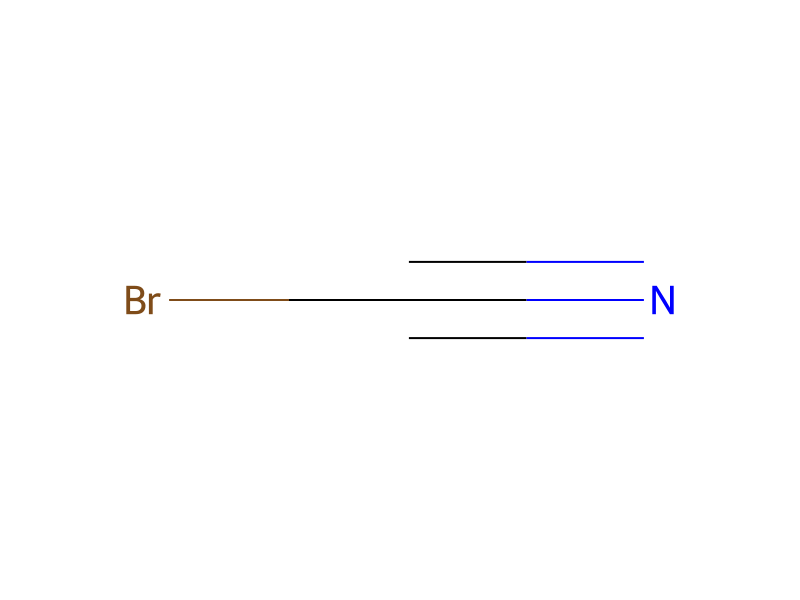
Cyanogen Bromide → 2-amino-6-nitrobenzoxazole
Reaction equation

[N:1]#[C:2]Br.[O-]Cl.[Na+].[NH2:7][C:8]1[CH:13]=[CH:12][C:11]([N+:14]([O-:16])=[O:15])=[CH:10][C:9]=1[OH:17].[OH-].[Na+]>O1CCCC1.O>[NH2:1][C:2]1[O:17][C:9]2[CH:10]=[C:11]([N+:14]([O-:16])=[O:15])[CH:12]=[CH:13][C:8]=2[N:7]=1Participants






Procedure
A solution of cyanogen bromide (3.50 g, 33 mmol; caution: highly toxic! Waste disposal: addition of excess NaOCl to a basic aqueous solution of cyanogen bromide) in tetrahydrofuran (3 mL) was added to a solution of 2-amino-5-nitrophenol (4.62 g, 30 mmol) in tetrahydrofuran (20 mL). After stirring for 1 day at r.t, a precipitate had formed which was dissolved by addition of water (5 mL). After stirring further 3 days at r.t., water (10 mL) was added and NaOH was added until the mixture turned basic. The tetrahydrofuran was removed in vacuo and the precipitate formed in the remaining aqueous phase was separated by filtration, washed with water and recrystallized from methanol (100 mL). Upon additional fractional crystallisation of the mother liquor, a total of 3.80 g (21.2 mmol, 71%) of 2-amino-6-nitrobenzoxazole was obtained as a brown solid. LC/ESI-MS: m/z=180 [M+H]+; m/z=178 [M]−H−; R=2.52 min.
Workup
- customa precipitate had formed which
- stirringAfter stirring further 3 days at r.t.
- customThe tetrahydrofuran was removed in vacuo
- customthe precipitate formed in the remaining aqueous phase
- customwas separated by filtration
- washwashed with water
- customrecrystallized from methanol (100 mL)
- customUpon additional fractional crystallisation of the mother liquor
Sources & evidence
- ORD record
- ord-1ff1c8fe5f34425c81008a9497626d81
- Source dataset
- uspto-grants-2009_08
- Patent number
- US07576090B2
Reaction notes
Loading…