Dicyclohexylcarbodiimide → 2-cyclobutylidene-N-(4-methoxy-2,3-dimethylphenyl)acetamide
Reaction equation

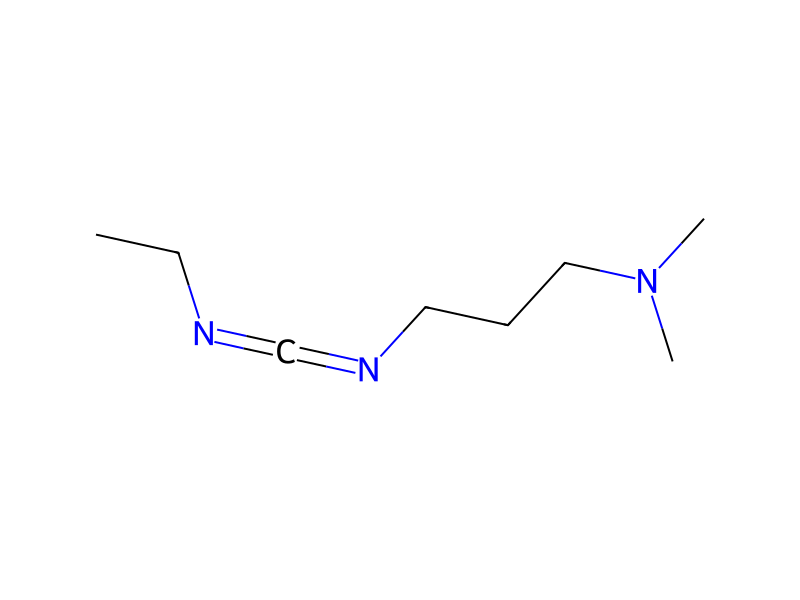
[C:1]1(=[CH:5][C:6]([OH:8])=O)[CH2:4][CH2:3][CH2:2]1.[CH3:9][C:10]1[C:11]([O:18][CH3:19])=[CH:12][CH:13]=[C:14]([C:16]=1[CH3:17])[NH2:15].CN(C)CCCN=C=NCC.C1(N=C=NC2CCCCC2)CCCCC1>CN(C)C1C=CN=CC=1.ClCCl.C(N(CC)CC)C>[C:1]1(=[CH:5][C:6]([NH:15][C:14]2[CH:13]=[CH:12][C:11]([O:18][CH3:19])=[C:10]([CH3:9])[C:16]=2[CH3:17])=[O:8])[CH2:2][CH2:3][CH2:4]1Participants
Reactant 4



Product 1

Reagents, catalysts & solvents 3



Procedure
Cyclobutylideneacetic acid (3.8 g), 5,6-dimethyl-4-methoxyaniline (5 g), 1-(3-dimethylaminopropyl)-3-ethylcarbodiimide (EDC) (4.7 g), 1,3-dicyclohexylcarbodiimide (DCC) (2.4 g), 4-dimethylaminopyridine (DMAP) (805 mg) and triethylamine (TEA) (7.3 g) were dissolved in dichloromethane (80 mL). The mixture was stirred at room temperature overnight, concentrated, and the residue dissolved in ethyl acetate. The organic phase was washed with water (3×20 mL) and 1M HCl (3×20 mL), and a white solid was filtered out. The organic solution was then dried out by evaporation giving 2-cyclobutylidene-N-(4-methoxy-2,3-dimethylphenyl)acetamide as a brown solid (5.3 g). The product was used in the next step without further purification. MS: (m/z)=246 (100, M+H+).
Workup
- concentrationconcentrated
- dissolutionthe residue dissolved in ethyl acetate
- washThe organic phase was washed with water (3×20 mL) and 1M HCl (3×20 mL)
- filtrationa white solid was filtered out
- customThe organic solution was then dried out by evaporation
Sources & evidence
- ORD record
- ord-e76f5d88b4074044a32e6ad90da2d763
- Source dataset
- uspto-grants-2009_08
- Patent number
- US07576094B2
Reaction notes
Loading…