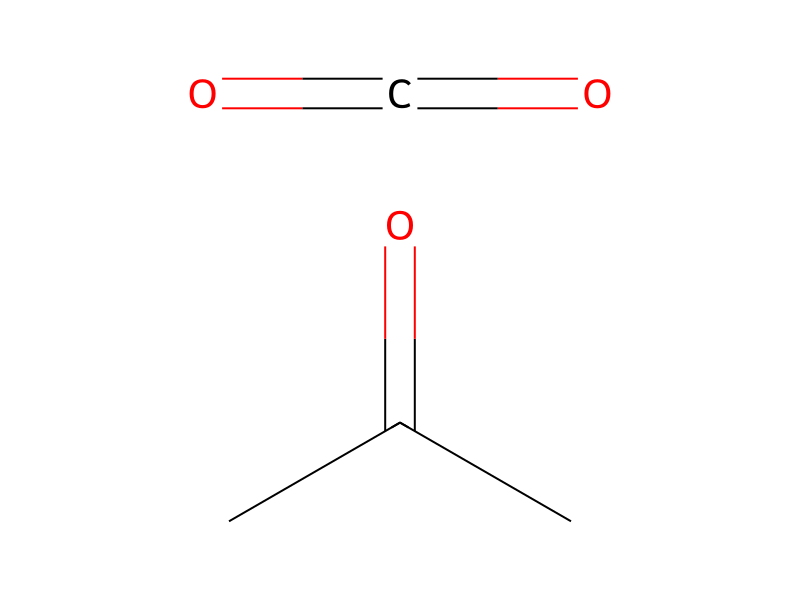
Carbon Dioxide → HCID 23707837, compound
Reaction equation

[CH2:1]1[O:12][CH:4]([C:5]2[S:9][C:8](Cl)=[N:7][C:6]=2[Cl:11])[O:3][CH2:2]1.C([Li:17])CCC.[C:18](=[O:20])=[O:19].CC(C)=O.C(=O)=O>O1CCCC1>[Li+:17].[Cl:11][C:6]1[N:7]=[C:8]([C:18]([O-:20])=[O:19])[S:9][C:5]=1[CH:4]1[O:12][CH2:1][CH2:2][O:3]1Participants
Reactant 4



Product 1

Reagents, catalysts & solvents 1

Procedure
2,4-Dichlorothiazole-5-carbaldehyde ethylene acetal (J. Chem. Soc. Perkin Trans. 1, p. 973 (1992)) (2.26 g) was dissolved in tetrahydrofuran (15 mL), and n-butyllithium (as 1.5N hexane solution, 6.8 mL) was added thereto while being cooled with dry ice-acetone. After the reaction mixture was stirred for 20 minutes, carbon dioxide gas was introduced into the mixture at the same temperature. The reaction mixture was gradually heated to room temperature over 1.5 hours, and the mixture was concentrated under reduced pressure. Hexane was added to the residue, and the resultant powder was collected by filtration. The powder was suspended in ethyl acetate, and the powder was collected by filtration again, to thereby give the title compound (1.65 g).
Workup
- concentrationthe mixture was concentrated under reduced pressure
- additionHexane was added to the residue
- filtrationthe resultant powder was collected by filtration
- filtrationthe powder was collected by filtration again
Sources & evidence
- ORD record
- ord-8bc3f401a6c74307807f8e486b85dc75
- Source dataset
- uspto-grants-2009_08
- Patent number
- US07576135B2
Reaction notes
Loading…