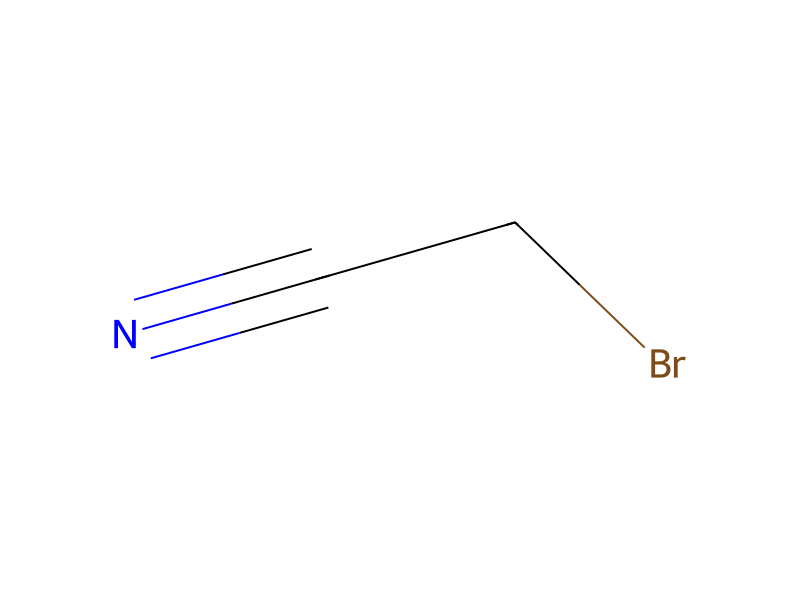
Bromoacetonitrile → HCID 14837015, compound
Reaction equation

[CH:1]([N:4](C(C)C)CC)(C)[CH3:2].BrCC#N.[F:14][C:15]1[C:16]([OH:28])=[N:17][CH:18]=[C:19]([O:21][C:22]([F:27])([F:26])[CH:23]([F:25])[F:24])[CH:20]=1>C(Cl)Cl>[C:1]([CH2:2][N:17]1[CH:18]=[C:19]([O:21][C:22]([F:26])([F:27])[CH:23]([F:24])[F:25])[CH:20]=[C:15]([F:14])[C:16]1=[O:28])#[N:4]Participants
5
Reactant 3


Product 1

Reagents, catalysts & solvents 1

Procedure
Diisopropylethylamine (0.82 ml, 4.7 mmol) and 0.30 ml (4.3 mmol) of bromoacetonitrile were added consecutively with stirring at ambient temperature to 3-fluoro-5-(1,1.2,2-tetrafluoroethoxy)-2-pyridinol (0.90 g, 3.98 mmol) in 5 ml of methylene chloride and the mixture allowed to react overnight. It was then diluted with 25 ml of methylene chloride, extracted with 25 ml of water and with dilute aqueous sodium carbonate, dried over sodium sulfate, and concentrated by evaporation under reduced pressure to obtain the title compound as a solid. This was recrystallized from toluene to obtain 0.92 g (86 percent of theory) of purified material melting at 75.5-77° C. The proton nmr spectrum was consistent with the assigned structure.
Workup
- customto react overnight
- extractionextracted with 25 ml of water and with dilute aqueous sodium carbonate
- dry with materialdried over sodium sulfate
- concentrationconcentrated by evaporation under reduced pressure
Sources & evidence
- ORD record
- ord-4c265d6afae6472590aaf47917247e5f
- Source dataset
- uspto-grants-1990_06
- Patent number
- US04931452
Reaction notes
Loading…