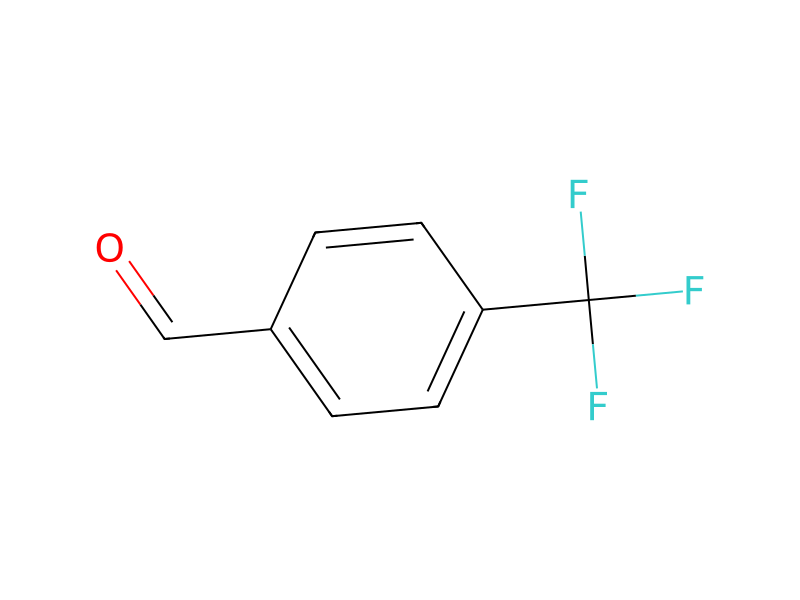
4-(Trifluoromethyl)benzaldehyde → 2-Propenoic acid, 3-[4-(trifluoromethyl)phenyl]-, ethyl ester
Reaction equation

[C:1]([CH:6]=P(C1C=CC=CC=1)(C1C=CC=CC=1)C1C=CC=CC=1)([O:3][CH2:4][CH3:5])=[O:2].[F:26][C:27]([F:37])([F:36])[C:28]1[CH:33]=[CH:32][C:31]([CH:34]=O)=[CH:30][CH:29]=1>C(Cl)Cl>[F:26][C:27]([F:37])([F:36])[C:28]1[CH:33]=[CH:32][C:31](/[CH:34]=[CH:6]/[C:1]([O:3][CH2:4][CH3:5])=[O:2])=[CH:30][CH:29]=1Participants



Procedure
To a solution of (carbethoxymethylene)triphenylphosphorane (55.3 g, 159 mmol) in 150 mL DCM, alpha,alpha,alpha-trifluoro-p-tolualdehyde (25.00 g, 144 mmol) in 75 mL DCM was added. The reaction is exothermic. The mixture was heated at reflux for 90 minutes. After removing the solvent, hexane was added to the resulting residue. A precipitate appeared and was filtered through filter paper. The collected solid was subjected to a silica gel chromatography with 100% hexane as the eluant to afford a white solid ((E)-ethyl 3-(4-(trifluoromethyl)phenyl)acrylate(25.0 g, yield=71%). LCMS (API-ES) m/z (%): 245.1 (100%, M++H); 1H NMR (400 MHz, CD3OD) δ ppm 1.35 (t, J=7.14 Hz, 3H) 4.28 (q, J=7.04 Hz, 2H) 6.68 (d, J=1 6.04 Hz, 1H) 7.70-7.77 (m, 3H) 7.80-7.84 (m, 2H).
Workup
- temperatureThe mixture was heated
- temperatureat reflux for 90 minutes
- customAfter removing the solvent, hexane
- additionwas added to the resulting residue
- filtrationwas filtered
- filtrationthrough filter paper
Sources & evidence
- ORD record
- ord-2e52fa49772b4e63aaa9367038a8a0e7
- Source dataset
- uspto-grants-2009_04
- Patent number
- US07514566B2
Reaction notes
Loading…