Iodine → (2R)-2,6-dimethylheptan-1-ol
반응식

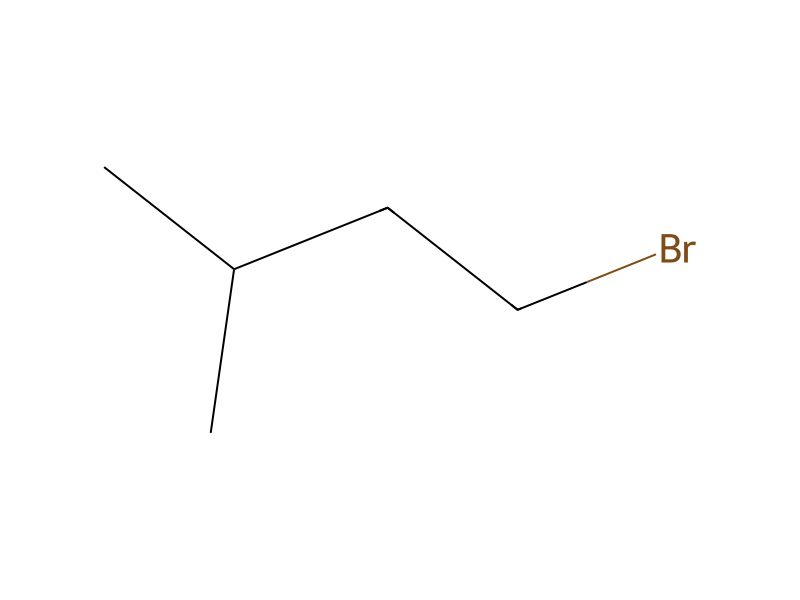
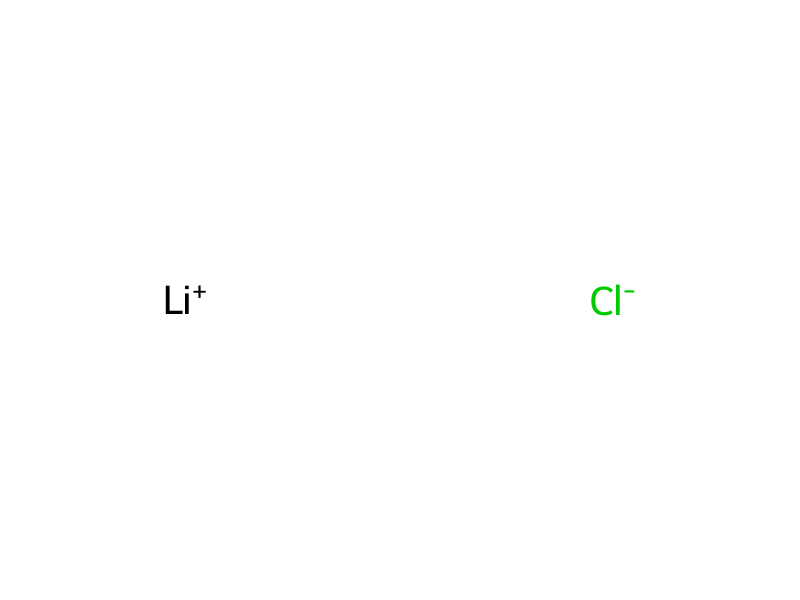
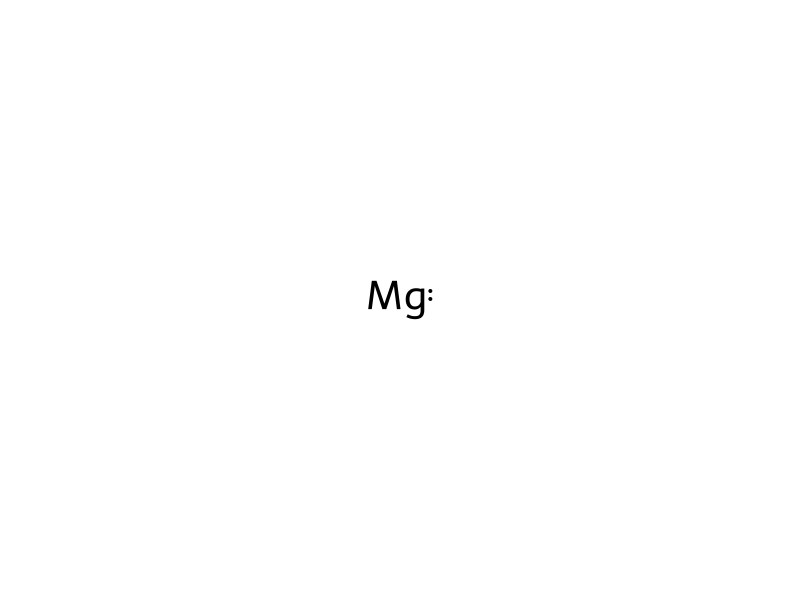
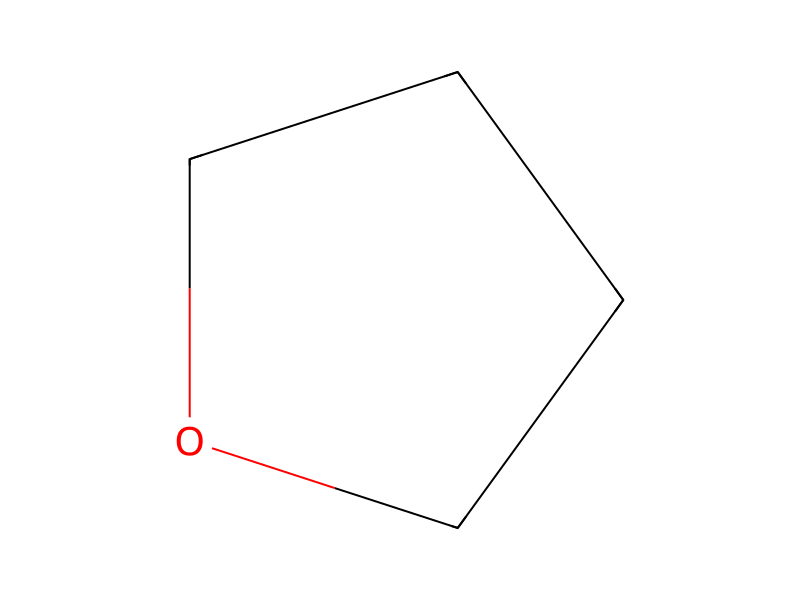
[Mg].II.Br[CH2:5][CH2:6][CH:7]([CH3:9])[CH3:8].[Li+].[Cl-].Br[CH2:13][C@H:14]([CH3:17])[CH2:15][OH:16]>C1COCC1.[Cu](Cl)Cl>[CH3:17][C@H:14]([CH2:13][CH2:5][CH2:6][CH:7]([CH3:9])[CH3:8])[CH2:15][OH:16]참가 물질



실험 절차
Magnesium tumings (2.04 g, 84 mmol) and a crystal of iodine were suspended in 5 mL THF for the addition of 1-bromo-3-methyl butane (0.3 mL, neat). The mixture was heated to start the Grignard formation. The remaining 1-bromo-3-methyl butane (8.63 mL, 72 mmol) was diluted in THF (60 mL) and added dropwise. The mixture was stirred at ambient temperature for 2 hours and cooled to −5° C. A solution of copper chloride (1.21 g, 9 mmol) and LiCl (0.76 g, 18 mmol) in THF (50 mL) was added dropwise keeping the temperature below 0° C. The resulting mixture was stirred for 20 min, and (R)-3-bromo-2-methylpropanol in THF (20 mL) was added dropwise while keeping the temperature below 0° C. The mixture was allowed to slowly reach ambient temperature overnight. The reaction mixture was quenched with ammonium hydroxide and water. The mixture was diluted with EtOAc and extracted with 3×20 mL EtOAc. The organics were washed with brine, dried (MgSO4), filtered and concentrated. The residual oil was purified via silica gel chromatography (90/10 Hexane/EtOAc) to give 2.67 g (R)-2,6-dimethyl heptan-1-ol. (R)-1-iodo-2,6-dimethyl heptane: To a mixture of supported triphenyl phosphine (6.55 g, 19.67 mmol) in CH2Cl2 at 0° C. was added iodine (4.99 g, 19.67 mmol) and imidazole (1.33 g, 19.67 mmol). The mixture was warmed to ambient temperature, stirred for 1 h and cooled to 0° C. for the dropwise addition of (R)-2,6-dimethyl heptan-1-ol in CH2Cl2 (5 mL). The mixture was allowed to reach ambient temperature and stirred for 1 h, at which time it was filtered through a pad of celite and the solids were washed with CH2Cl2. The filtrated was concentrated, and the crude product was purified via silica gel chromatography to give (R)-1-iodo-2,6-dimethyl heptane (2.44 g). (4R)-4,8-dimethyl nonanoic acid t-butyl ester: To diisopropyl amine (0.827 mL, 5.9 mmol) in THF (8 mL) at −78° C. was added nBuLi (2.65 mL of a 2.6 M solution in pentane). The solution was stirred for 30 min at −78° C., followed by the addition of t-butyl acetate (0.8 mL, 5.9 mmol). The mixture was stirred at −78° C. for 2 h, and then (R)-1-iodo-2,6-dimethyl heptane (0.3 g, 1.18 mmol) and HMPA (1.5 mL) in THF (1 mL) was added. The reaction was stirred at −78° C. and allowed to slowly reach ambient temperature overnight, then heated at 35° C. to drive the reaction to completion. The reaction was quenched by the addition of ammonium chloride (saturated aqueous solution), and the mixture was extracted with EtOAc (2×10 mL). The organics were combined, washed with water, dried (MgSO4), filtered and concentrated. Silica gel chromatography (98/2 hexane/EtOAc) provided 0.25 g of (4R)-4,8-dimethyl nonanoic acid t-butyl ester. (4R)-4,8-dimethyl nonanoic acid: (4R)-4,8-dimethyl nonanoic acid t-butyl ester in 25 mL CH2Cl2 at 0° C. was treated with TFA (6 mL). The mixture was allowed to reach ambient temperature and stir overnight. The solvent was removed by rotary evaporation, and the mixture was purified by silica gel chromatography (95/5 hexane/EtOAc) to give 0.962 g (4R)-4,8-dimethyl nonanoic acid. m/z 185 (M−). 3-(4R,8-Dimethyl-nonanoyl)-4(S)-methyl-5(R)-phenyl-oxazolidin-2-one: A procedure similar to (4R,5S)-4-Methyl-3-(R)4-methyl-heptanoyl)-5-oxazolidin-2-one was utilized to give 3-(4R,8-Dimethyl-nonanoyl)-4(S)-methyl-5(R)-phenyl-oxazolidin-2-one (1.35 g) m/z 346.5 (M+). [4R,8-Dimethyl-2R-(4R-methyl-2-oxo-5R-phenyl-oxazolidine-3-carbonyl)-nonyl]-carbamic acid benzyl ester: To a solution of 3-(4(R),8-Dimethyl-nonanoyl)-4(S)-methyl-5(R)-phenyl-oxazolidin-2-one (1.05 g, 3.04 mmol) in CH2Cl2 (12 mL) and TiCl4 (3.04 mL of a 1 M solution in CH2Cl2) was added diisopropyl ethyl amine (0.55 mL, 3.19 mmol)at −20° C. The resulting dark red solution was stirred at −20° C. for 30 min prior to the addition of a solution of N-methoxymethyl benzyl carbamate (0.652 g, 3.34 mmol) in CH2Cl2 (3.5 mL) and TiCl4 (3.34 mL). The mixture was stirred at 0° C. for 4 h. The reaction was quenched by the addition of saturated aqueous ammonium chloride solution. The mixture was extracted with CH2Cl2 (3×15 mL). The organics were combined and washed with 1 N HCl and neutralized with NaOH, followed by washing with brine. The organics were dried (MgSO4), filtered, concentrated and purified by silica gel chromatography (95/5 hexane/EtOAc) to give 0.555 g [4R,8-Dimethyl-2R-(4R-methyl-2-oxo-5R-phenyl-oxazolidine-3-carbonyl)-nonyl]-carbamic acid benzyl ester. 2(R)-(Benzyloxycarbonylamino-methyl)-4(R),8 dimethyl-nonanoic acid: A procedure similar to that of (S)-2-((R)-2-Methyl=pentyl)succinic acid t-butyl ester was utilized to provide 0.198 g 2(R)-(Benzyloxycarbonylamino-methyl)4(R),8-dimethyl-nonanoic acid. 2-aminomethyl-4,8-dimethyl nonanoic acid: 2(R)-(Benzyloxycarbonylamino-methyl)-4(R),8-dimethyl-nonanoic acid (0.148 g, 0.566 mmol) was treated with hydrogen in the presence of 20% pd/C to give 0.082 g of 2-aminomethyl-4,8-dimethyl nonanoic acid after filtration and purification via silica gel chromatography (85/15 CH2Cl2/MeOH). m/z 216.3 (M+).
후처리
- temperatureThe mixture was heated
- additionadded dropwise
- temperaturecooled to −5° C
- customthe temperature below 0° C
- stirringThe resulting mixture was stirred for 20 min
- customthe temperature below 0° C
- customwas allowed to slowly reach ambient temperature overnight
- customThe reaction mixture was quenched with ammonium hydroxide and water
- additionThe mixture was diluted with EtOAc
- extractionextracted with 3×20 mL EtOAc
- washThe organics were washed with brine
- dry with materialdried (MgSO4)
- filtrationfiltered
- concentrationconcentrated
- customThe residual oil was purified via silica gel chromatography (90/10 Hexane/EtOAc)
출처 및 근거
- ORD 기록
- ord-b9e7f8e2e3fa49a69afe71cf5c950e63
- 출처 데이터셋
- uspto-grants-2009_04
- 특허 번호
- US07517909B2
반응 노트
불러오는 중…