Ammonia → Ammonia
Reaction equation

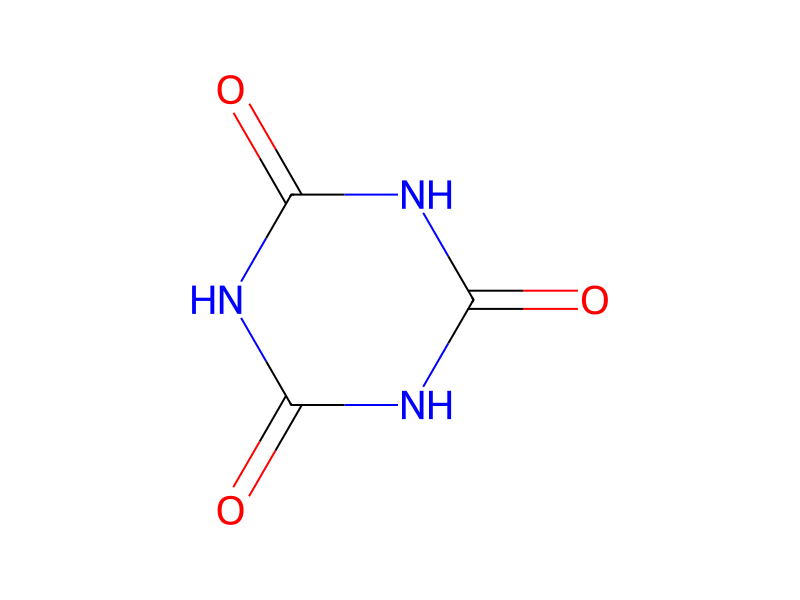
[NH2:1][C:2]([NH2:4])=[O:3].N.[NH:6]=C=O.N[C:10]([NH:12][C:13](N)=[O:14])=[O:11]>>[NH:1]1[C:13](=[O:14])[NH:12][C:10](=[O:11])[NH:4][C:2]1=[O:3].[NH3:6]Participants




Procedure
The selective control over pH may be accomplished using any of a variety of well-known buffering systems known in the art. One such buffering system utilizes urea thermal decomposition (i.e., pyrolysis) to increase pH to the desired value. The pyrolysis of urea is well known, and has been described in, for instance, Study of the Urea Decomposition (Pyrolysis) Reaction and Importance to Cyanuric Acid Production, Peter M. Shaber, et al., American Laboratory (August 1999), which is incorporated herein in its entirety by reference thereto for all purposes. For instance, to initiate the pyrolysis reaction, urea is first heated to its melting point of approximately 135° C. With continued heating to approximately 150° C., the urea is vaporized (Eq. 1) and is then decomposed into ammonia and isocyanic acid (Eq. 2). The urea also reacts with the isocyanic acid byproduct to form biuret (Eq. 3). H2N—CO—NH2(m)+heat=H2N—CO—NH2(g) (1) H2N—CO—NH2(g)+heat NH3(g)+HNCO(g) (2) H2N—CO—NH2(m)+HNCO(g)H2N—CO—NH—CO—NH2(s) (3) Upon further heating, e.g., to about 175° C., the biuret referenced above reacts with isocyanic acid to form cyanuric acid and ammonia (Eq. 4), as well as ammelide and water (Eq. 5). H2N—CO—NH—CO—NH2(m)+HNCO(g)CYA(s)+NH3(g) (4) H2N—CO—NH—CO—NH2(m)+HNCO(g)ammelide(s)+H2O(g) (5) As the temperature is further increased, other reactions begin to occur. For instance, biuret may decompose back into urea and isocyanic acid. The urea produced is unstable at higher temperatures, and thus, will further decompose into ammonia and isocyanic acid. Urea and the byproducts of the pyrolysis reaction will continue to react and further decompose as the reaction mixture is heated.
Workup
- customto about 175° C.
Sources & evidence
- ORD record
- ord-af91203af659486682c6c41277de4a61
- Source dataset
- uspto-grants-2008_10
- Patent number
- US07438875B2
Reaction notes
Loading…