Lauric Acid → 2,6-dimethyl-7a-undecyl-tetrahydro-2H-oxazolo[2,3-b]oxazole
Reaction equation

[CH3:1][CH:2]([OH:9])[CH2:3][NH:4][CH2:5][CH:6]([OH:8])[CH3:7].[C:10](O)(=O)[CH2:11][CH2:12][CH2:13][CH2:14][CH2:15][CH2:16][CH2:17][CH2:18][CH2:19][CH2:20][CH3:21]>O>[CH3:1][CH:2]1[O:9][C:21]2([CH2:20][CH2:19][CH2:18][CH2:17][CH2:16][CH2:15][CH2:14][CH2:13][CH2:12][CH2:11][CH3:10])[O:8][CH:6]([CH3:7])[CH2:5][N:4]2[CH2:3]1Participants
Reactant 2
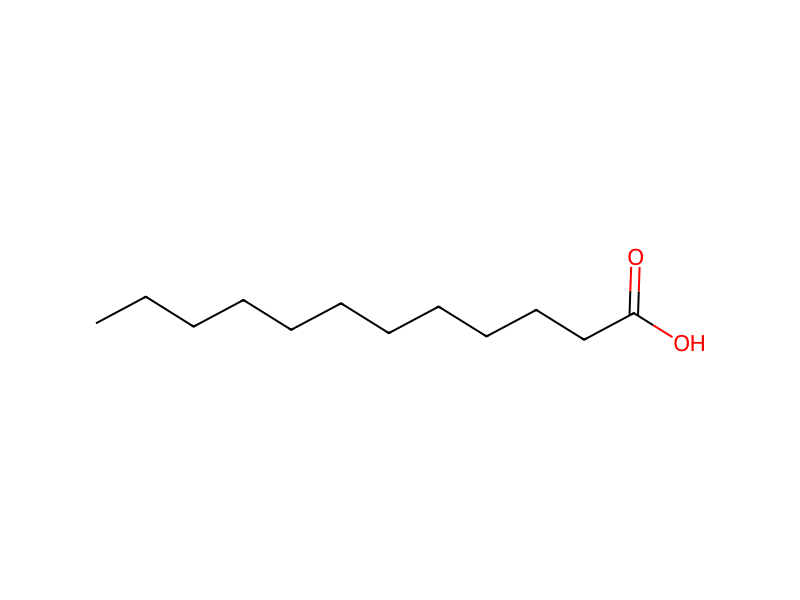

Product 1

Reagents, catalysts & solvents 1

Conditions
- Temperature
- 180 °C
Procedure
To a 1 liter stirred reactor, equipped with a distillation column, condenser, and graduated receiver, the following constituents were added: 164.9 g of diisopropanol amine (DIPA, ChemCentral, Milwaukee, New Berlin, Wis.) and 201.5 g (98%) of lauric acid (Aldrich Chemical Co., Milwaukee, Wis.). The contents were heated to 180° C. under a nitrogen blanket. After 80 minutes, 17 ml of water had come overhead (1 equivalent). The batch temperature was held at 180° C. while the pressure was dropped to 320 Pa. The batch temperature was then raised to 195° C. During the pressure reduction and heat-up, unreacted DIPA (60 g) came overhead. A total of 199.4 g of amide acetal derived from lauric acid was then collected while the temperature was raised from 195 to 222° C. at a pressure of 320-466 Pa. This represents a 66.7% conversion of the lauric acid. Gas chromatography (GC) was used for the determination of diisopropanol amine (DIPA) and amide acetal content in the liquid samples. Liquid samples from the reactor and from the overhead receiver were analyzed for the presence of DIPA and amide acetal product using an internal standard GC method. The GC was calibrated using pure DIPA and amide acetal. Samples were removed, weighed, diluted with known amount of internal standard in methylene chloride, and then injected into the GC.
Workup
- customequipped with a distillation column, condenser
- additionthe following constituents were added
- customwas held at 180° C. while the pressure
- additionwas dropped to 320 Pa
- temperatureThe batch temperature was then raised to 195° C
- temperatureDuring the pressure reduction and heat-up
- customwas then collected while the temperature
- temperaturewas raised from 195 to 222° C. at a pressure of 320-466 Pa
- customSamples were removed
- additiondiluted
Sources & evidence
- ORD record
- ord-afd1d467e0464fd8be1e2e48dac38830
- Source dataset
- uspto-grants-2008_10
- Patent number
- US07439354B2
Reaction notes
Loading…