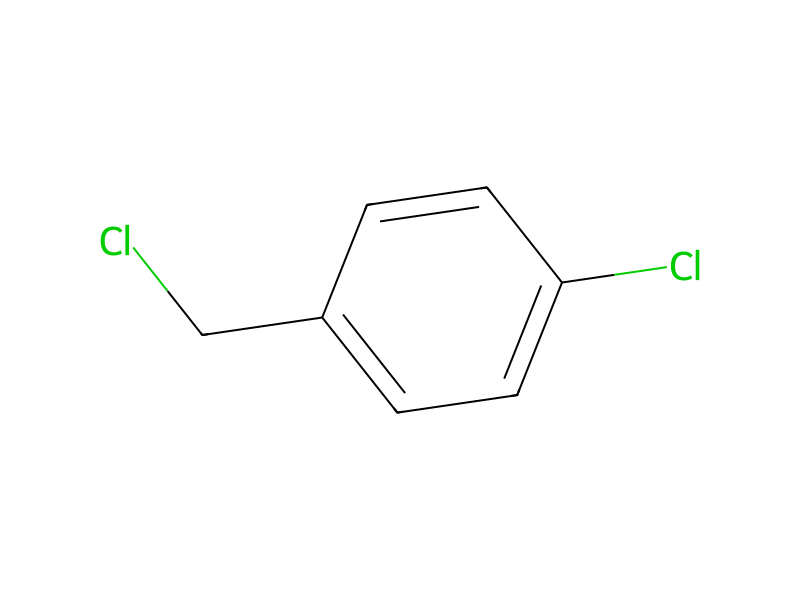
1-Chloro-4-(chloromethyl)benzene → 4-(4-Chlorophenyl)-3,3-dimethylbutan-2-one
Reaction equation

[OH-].[K+].[Cl:3][C:4]1[CH:11]=[CH:10][C:7]([CH2:8]Cl)=[CH:6][CH:5]=1.[CH:12]([C:15]([CH3:17])=[O:16])([CH3:14])[CH3:13]>C1(C)C=CC=CC=1.[Br-].C([N+](CCCC)(CCCC)CCCC)CCC>[Cl:3][C:4]1[CH:11]=[CH:10][C:7]([CH2:8][C:12]([CH3:14])([CH3:13])[C:15](=[O:16])[CH3:17])=[CH:6][CH:5]=1Participants
6





Conditions
- Temperature
- 85 °C
Procedure
254 g (4 mols) of potassium hydroxide powder (88% pure) are suspended in 1 liter of toluene. To this are slowly added 40 g of tetrabutylammonium bromide and a mixture of 644 g (4 mols) of 4-chlorobenzyl chloride and 430 g (5 mols) of methyl isopropyl ketone at 85° C. The reaction mixture is stirred a further 3 hours at 85° C. After cooling down, it is filtered and the filtrate is washed to neutrality. 732.5 g (87% of theory) of 1-(4-chlorophenyl)-2,2-dimethyl-3-butanone of boiling point 87°-90° C./0.05 mbar are obtained by fractional distillation under high vacuum.
Workup
- temperatureAfter cooling down
- filtrationit is filtered
- washthe filtrate is washed to neutrality
Sources & evidence
- ORD record
- ord-27488595677b4b88accbbb24c8511c93
- Source dataset
- uspto-grants-1987_07
- Patent number
- US04681952
Reaction notes
Loading…