Potassium Iodide → 5-Chloro-2-hydroxy-3-iodobenzaldehyde
Reaction equation

[Cl:1][C:2]1[CH:9]=[C:6]([CH:7]=[O:8])[C:5]([OH:10])=[CH:4][CH:3]=1.[I:11]N1C(=O)CCC1=O.IC1C=C(Br)C=C(C=O)C=1O.BrC1C=C(C=O)C(O)=CC=1.[I-].[K+].CC1C=CC(S(NCl)(=O)=O)=CC=1>CN(C=O)C.C(#N)C>[I:11][C:4]1[CH:3]=[C:2]([Cl:1])[CH:9]=[C:6]([CH:7]=[O:8])[C:5]=1[OH:10]Participants
9
Reactant 6

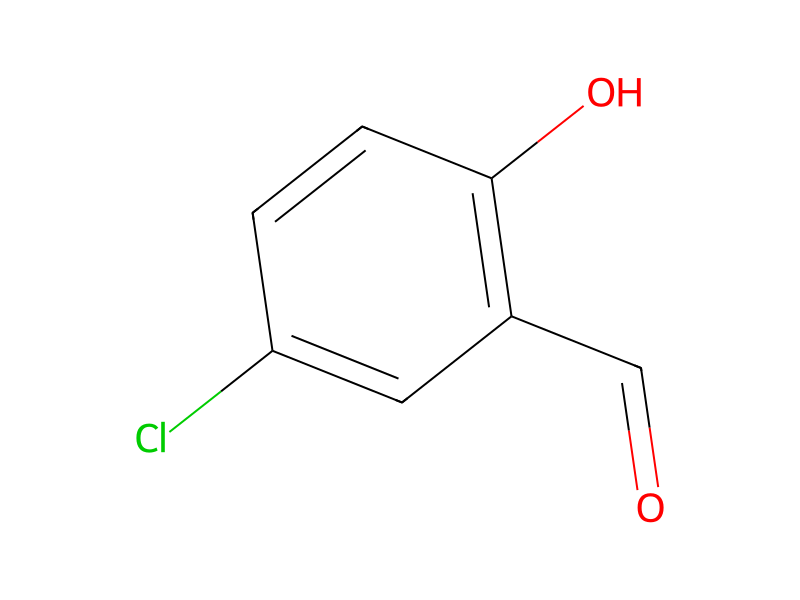


Product 1

Reagents, catalysts & solvents 2


Procedure
Some product precipitates and is recovered by filtration. The remainder is recovered by diluting the filtrate with water and isolating the precipitate. Combining the solids and drying gives 3-chloro-5-bromo-2-hydroxybenzaldehyde. 3-iodo-5-chlorosalicylaldehyde was prepared by reacting 5-chlorosalicylaldehyde with N-iodosuccinimide in DMF and subjecting the reaction mixture to conventional work-up conditions. 3-iodo-5-bromosalicylaldehyde can be prepared by reacting 5-bromosalicylaldehyde in acetonitrile with potassium iodide and chloramine T. Conventional work-up gives a material that when treated with hexanes gives the desired 3-iodo-5-chlorosalicylaldehyde.
Workup
- custom3-iodo-5-chlorosalicylaldehyde was prepared
- customConventional work-up gives a material that when
Sources & evidence
- ORD record
- ord-c15464c3e51a476f995215ebaed46267
- Source dataset
- uspto-grants-2004_02
- Patent number
- US06689754B1
Reaction notes
Loading…