Carbon Dioxide → thiophene-2,3-dicarboxylic acid
Reaction equation

[S:1]1[CH:5]=[CH:4][CH:3]=[C:2]1[C:6]([OH:8])=[O:7].C([Li])CCC.[C:14](=[O:16])=[O:15]>C1COCC1>[S:1]1[CH:5]=[CH:4][C:3]([C:14]([OH:16])=[O:15])=[C:2]1[C:6]([OH:8])=[O:7]Participants
Reactant 3

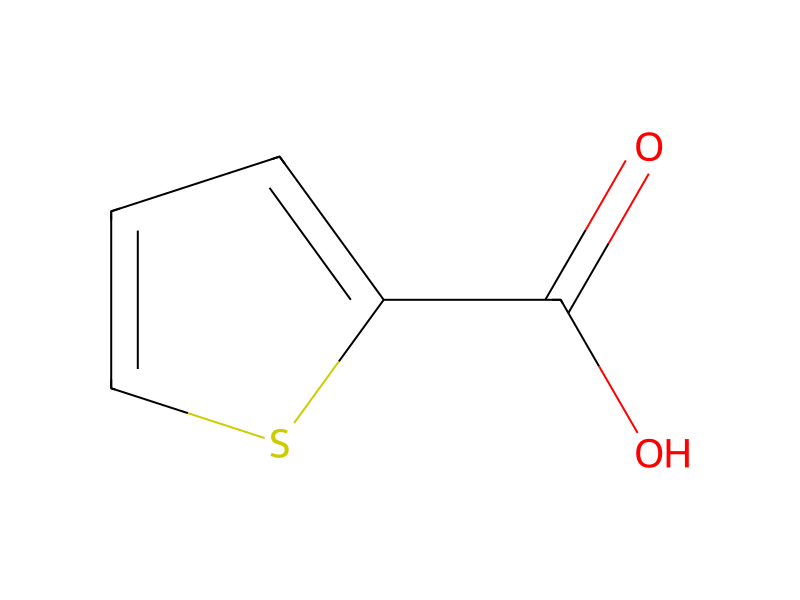

Product 1

Reagents, catalysts & solvents 1

Conditions
- Temperature
- -78 °C
Procedure
A dry, 2 L, 3-necked, round-bottomed flask was equipped with a mechanical stirrer and addition funnel. To the flask was added 2-thiophenecarboxylic acid (25 g, 195 mmol) in anhydrous THF (500 mL) under argon. The mixture was cooled to −78° C. with a dry ice-isopropanol bath and allowed to stir for 30 min. n-Butyllithium in Hexanes (2.5 M, 172 mL) was added dropwise over 30 min. The reaction was kept at −78° C. for an additional hour with stirring then placed under an atmosphere of dry carbon dioxide. With addition of the carbon dioxide the reaction became thick. The reaction remained at −78° C. for an additional hour before warming to −10° C. The reaction was quenched with 2 N HCl (213 mL) and allowed to reach rt. The layers were separated and the aqueous layer was extracted with EtOAc (3×200 mL). The organic layers were combined, dried (Na2SO4) and concentrated by rotary evaporation. The brown solid was crystallized from hot isopropanol and dried overnight under vacuum. Desired thiophene-2,3-dicarboxylic acid was obtained (27.3 g, 159 mmol; 82% yield); 1H NMR (DMSO-d6) 7.69 (d, J=1.5, 1), 7.38 (d, J=4.8, 1); ES MS (M+H)+=173; TLC (Chloroform-MeOH-water, 6:4:1); Rf=0.74.
Workup
- customA dry, 2 L, 3-necked, round-bottomed flask was equipped with a mechanical stirrer and addition funnel
- additionwas added dropwise over 30 min
- waitThe reaction was kept at −78° C. for an additional hour
- waitThe reaction remained at −78° C. for an additional hour
- temperaturebefore warming to −10° C
- customThe reaction was quenched with 2 N HCl (213 mL)
- customto reach rt
- customThe layers were separated
- extractionthe aqueous layer was extracted with EtOAc (3×200 mL)
- dry with materialdried (Na2SO4)
- concentrationconcentrated by rotary evaporation
- customThe brown solid was crystallized from hot isopropanol
- customdried overnight under vacuum
Sources & evidence
- ORD record
- ord-2a54bac0c0c9467aa1d92283cd639bda
- Source dataset
- uspto-grants-2004_02
- Patent number
- US06689883B1
Reaction notes
Loading…