Alendronic Acid → Alendronate sodium anhydrous
Reaction equation

[CH2:1]([CH2:13][NH2:14])[CH2:2][C:3]([P:9]([OH:12])([OH:11])=[O:10])([P:5]([OH:8])([OH:7])=[O:6])[OH:4].O.[Na].[OH-].[Na+:18].C(CN)CC(P(O)(O)=O)(P(O)(O)=O)O>O.C(O)C>[CH2:1]([CH2:13][NH2:14])[CH2:2][C:3]([P:5]([O-:7])([OH:8])=[O:6])([P:9]([OH:12])([OH:11])=[O:10])[OH:4].[Na+:18]Participants
Reactant 4
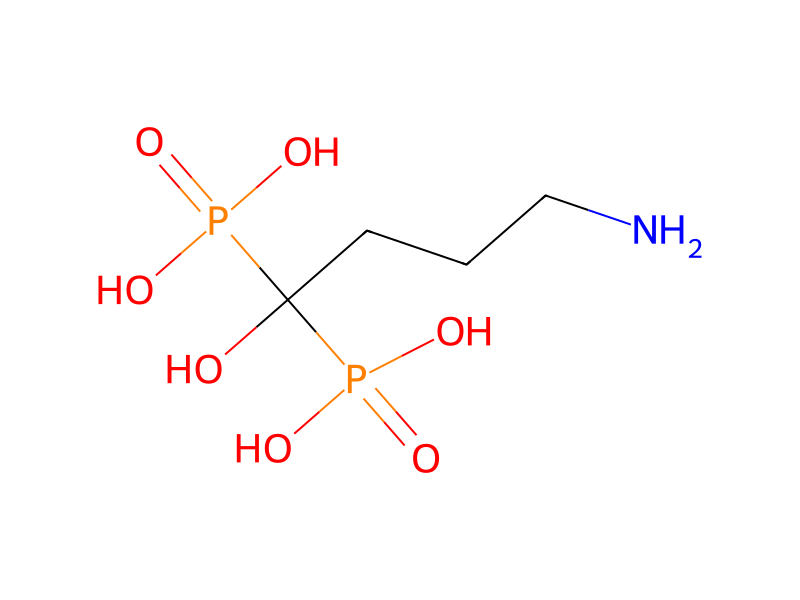



Product 1

Reagents, catalysts & solvents 2


Procedure
In accordance with the aspects of this invention wherein alendronic acid monohydrate is converted to,alendronate sodium, alendronic acid monohydrate as prepared by any of the known methods is added to an alkanol, preferably ethanol, together with a sodium base, preferably sodium hydroxide, and a desired amount of water. The amount of water depends upon the crystal form that is desired. The molar ratio of sodium base to alendronic acid is 1:1. The reaction mixture is boiled under reflux while stirring vigorously for approximately 15 hours, until the pH of the liquid phase remains constant (approx. pH 7). Crystalline alendronate sodium is then isolated, preferably by filtration after cooling to ambient temperature followed by washing with absolute ethanol, washing with absolute ether and drying overnight in a vacuum oven at ambient temperature and at a pressure of 10 mm to 15 mm of mercury.
Workup
- customas prepared by any of the known methods
- temperatureunder reflux
Sources & evidence
- ORD record
- ord-2a0370113f454ed7aa1f47e273b38a10
- Source dataset
- uspto-grants-2004_02
- Patent number
- US06696601B2
Reaction notes
Loading…