Dicyclohexylamine → HCID 16049965, compound
Reaction equation

C(OC(N[C@H](C(O)=O)CC1C=CC(O)=CC=1)=O)(C)(C)C.[CH:21]1([NH:27][CH:28]2[CH2:33][CH2:32][CH2:31][CH2:30][CH2:29]2)[CH2:26][CH2:25][CH2:24][CH2:23][CH2:22]1.[Br:34]CC(OCC)=O>CN(C)C=O>[BrH:34].[CH:28]1([NH:27][CH:21]2[CH2:22][CH2:23][CH2:24][CH2:25][CH2:26]2)[CH2:29][CH2:30][CH2:31][CH2:32][CH2:33]1Participants
Reactant 3
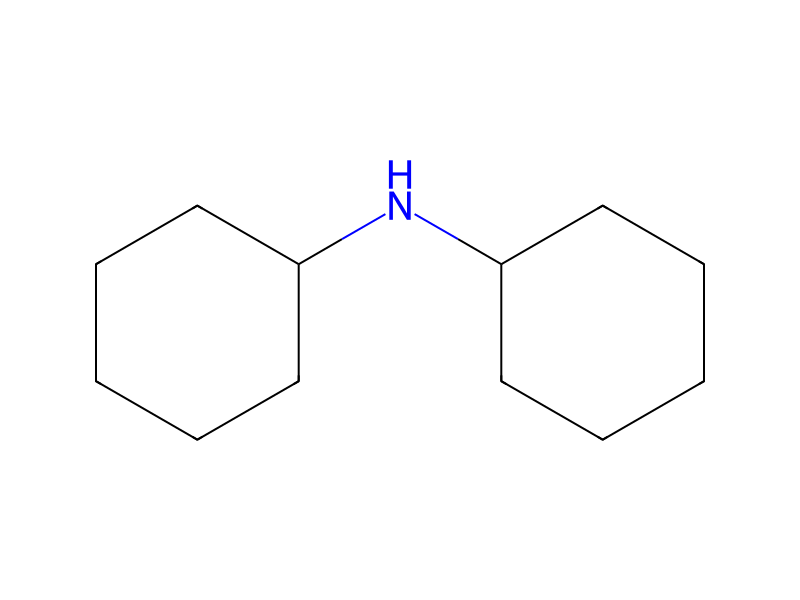


Product 1

Reagents, catalysts & solvents 1

Procedure
A mixture of 7 g (0.025 mol) of t-butyloxycarbonyl-L-tyrosine, 4.53 g (0.025 mol) of dicyclohexylamine and 4.18 g (0.025 mol) of ethyl bromoacetate in 40 ml of dimethylformamide is stirred for 15 hours. The precipitate of dicyclohexylamine hydrobromide which has formed is filtered off and washed with ethyl acetate. The combined filtrates are evaporated to dryness under reduced pressure. An oily residue is obtained which is taken up in ethyl acetate and washed twice with a 2N solution of sulphuric acid, once with water, twice with a solution of potassium bicarbonate and, finally, once with water. After desiccation over magnesium sulphate, the solution is evaporated to dryness. An oily residue is obtained which is dissolved in 50 ml of acetic acid containing 1.8 g (0.05 mol) of gaseous hydrochloric acid. The solution is allowed to stand for 30 minutes and then evaporated to dryness under reduced pressure, and the residue is recrystallised several times from a mixture of isopropanol and ether. 5.7 g of the hydrochloride (yield 75%), which melts at 176°, are collected. [α]Dt = + 12.2°.
Sources & evidence
- ORD record
- ord-995d7f5777014ffcbd1ac5c95e327711
- Source dataset
- uspto-grants-1979_01
- Patent number
- US04134991
Reaction notes
Loading…