Hydrogen Peroxide → Sodium percarbonate
Reaction equation

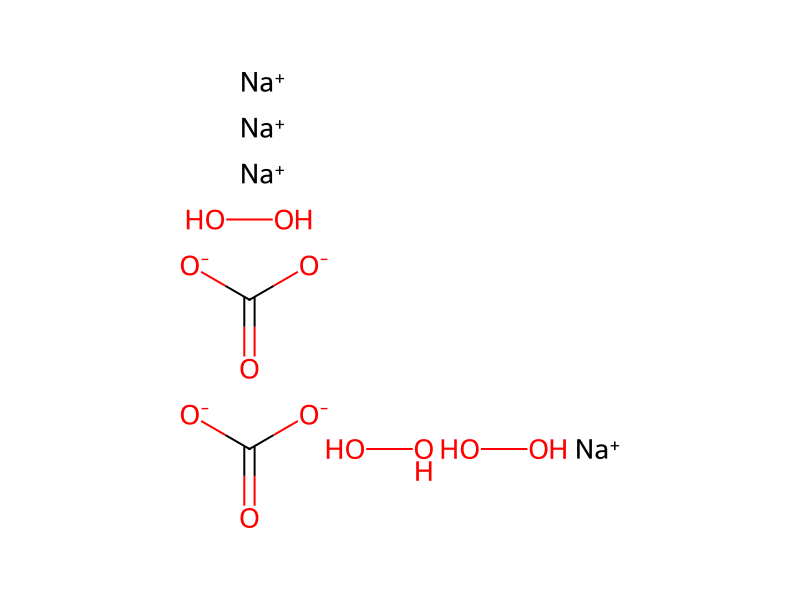
[C:1](=[O:4])([O-:3])[O-:2].[Na+:5].[Na+].[OH-:7].[Na+].[OH:9]O>>[C:1]([O-:4])([O-:3])=[O:2].[C:1]([O-:4])([O-:3])=[O:2].[OH:7][OH:9].[OH:7][OH:9].[OH:7][OH:9].[Na+:5].[Na+:5].[Na+:5].[Na+:5]Participants
4



Procedure
We have found that one convenient way of obtaining a pH in the range of 10.5 to 11.5 is to use sodium carbonate or sodium hydroxide. According to a modification of the process the hydrogen peroxide is provided in situ by dissolution of sodium percarbonate, (food and drug grade). By sodium percarbonate we mean the addition product of hydrogen peroxide and sodium carbonate having the stoichiometric composition Na2CO3.3/2H2O2. Generally speaking bleaching using an equivalent amount of sodium percarbonate has the advantage that addition of carbonate to regulate the pH occurs simultaneously with addition of hydrogen peroxide and in consequence simplifies the process.
Sources & evidence
- ORD record
- ord-8f56eccde1b14ec7ac296c17c787c51a
- Source dataset
- uspto-grants-1979_01
- Patent number
- US04136204
Reaction notes
Loading…