Pyridine → Methyl {[(4-nitrophenoxy)carbonyl]oxy}acetate
Reaction equation

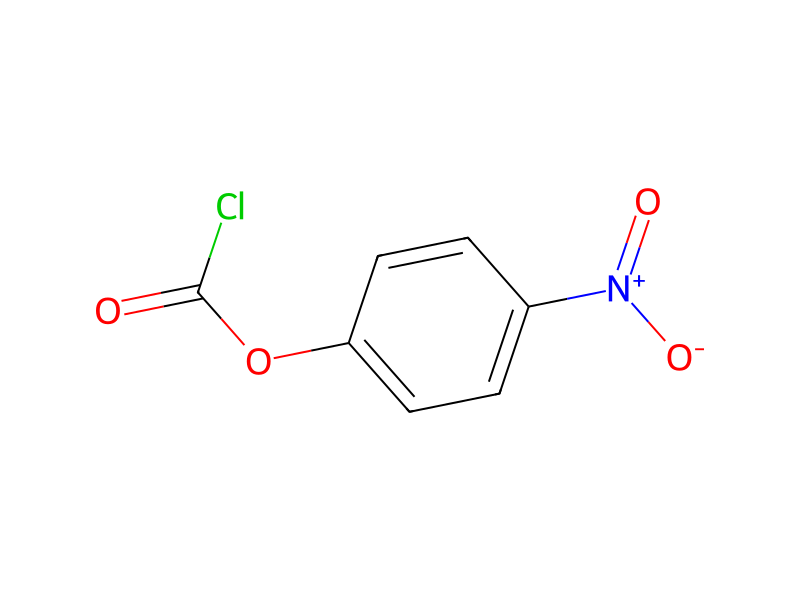
[C:1]([O:5][CH3:6])(=[O:4])[CH2:2][OH:3].N1C=CC=CC=1.Cl[C:14]([O:16][C:17]1[CH:22]=[CH:21][C:20]([N+:23]([O-:25])=[O:24])=[CH:19][CH:18]=1)=[O:15]>C(Cl)Cl>[N+:23]([C:20]1[CH:21]=[CH:22][C:17]([O:16][C:14]([O:3][CH2:2][C:1]([O:5][CH3:6])=[O:4])=[O:15])=[CH:18][CH:19]=1)([O-:25])=[O:24]Participants
Reactant 3


Product 1

Reagents, catalysts & solvents 1

Procedure
A mixture of 640 mg of methyl glycolate, 0.60 mL of pyridine, and 10 mL of methylene chloride was added to 10 mL of a methylene chloride solution including 1.44 g of 4-nitrophenyl chloroformate at room temperature, followed by stirring for 2 hours at room temperature. The reaction mixture was concentrated under reduced pressure, and diethyl ether and water were added to the residue and an organic layer was separated. The organic layer was sequentially washed with water and saturated brine and dried over anhydrous sodium sulfate, followed by concentration under reduced pressure. The residue was purified by silica gel column chromatography (using chloroform only), thereby obtaining 320 mg of methyl {[(4-nitrophenoxy)carbonyl]oxy}acetate.
Workup
- customat room temperature
- concentrationThe reaction mixture was concentrated under reduced pressure, and diethyl ether and water
- additionwere added to the residue
- customan organic layer was separated
- washThe organic layer was sequentially washed with water and saturated brine
- dry with materialdried over anhydrous sodium sulfate
- concentrationfollowed by concentration under reduced pressure
- customThe residue was purified by silica gel column chromatography (
Sources & evidence
- ORD record
- ord-1ca31ed2a81144edad6e429a4a6edf65
- Source dataset
- uspto-grants-2015_06
- Patent number
- US09062032B2
Reaction notes
Loading…