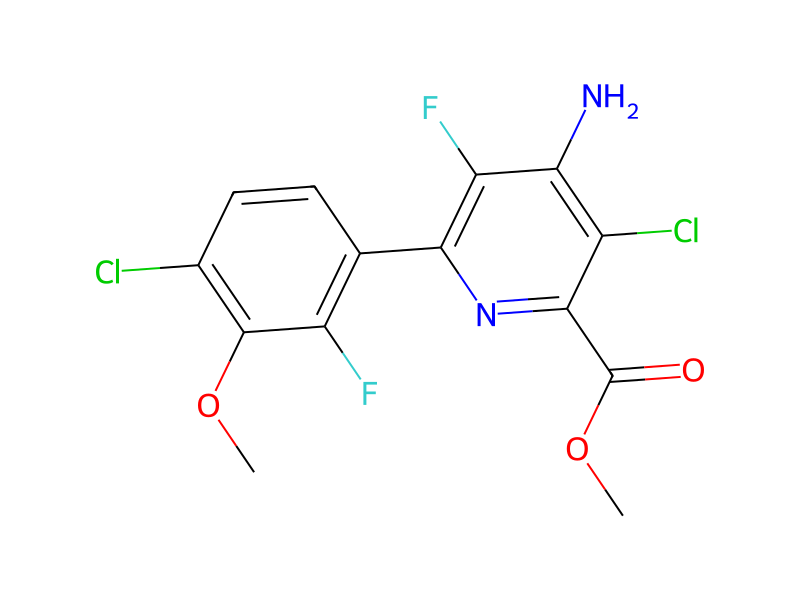
Potassium Fluoride → Methyl 4-amino-3-chloro-6-(4-chloro-2-fluoro-3-methoxyphenyl)-5-fluoropicolinate
Reaction equation

[NH2:1][C:2]1[C:7]([F:8])=[C:6](Br)[N:5]=[C:4]([C:10]([O:12][CH3:13])=[O:11])[C:3]=1[Cl:14].[Cl:15][C:16]1[CH:21]=[CH:20][C:19](B2OCCCO2)=[C:18]([F:28])[C:17]=1[O:29][CH3:30].[F-].[K+]>C(#N)C.O>[NH2:1][C:2]1[C:7]([F:8])=[C:6]([C:19]2[CH:20]=[CH:21][C:16]([Cl:15])=[C:17]([O:29][CH3:30])[C:18]=2[F:28])[N:5]=[C:4]([C:10]([O:12][CH3:13])=[O:11])[C:3]=1[Cl:14]Participants
Reactant 3



Product 1
Reagents, catalysts & solvents 2


Conditions
- Temperature
- 50 °C
Procedure
A stream of nitrogen was passed through a colorless mixture of methyl 4-amino-6-bromo-3-chloro-5-fluoropicolinate (2.8 g, 10 mmol) and 2-(4-chloro-2-fluoro-3-methoxyphenyl)-1,3,2-dioxaborinane (3.2 g, 13 mmol) in acetonitrile (CH3CN; 40 mL) and KF (1.7 g, 30 mmol) in H2O (20 mL) while heating to 50° C. (20-30 min). Dichloro-bis(triphenylphosphine)palladium(II) (PdCl2(PPh3)2; 140 mg, 0.2 mmol) was added, and the mixture was heated to 65° C. The reaction was monitored by HPLC and was complete after 5 h. The reaction mixture was filtered hot through a short pad of Celite then was diluted with H2O (20 mL) and allowed to cool. The product was collected by filtration. The light tan solid was dried under vacuum to give methyl 4-amino-3-chloro-6-(4-chloro-2-fluoro-3-methoxyphenyl)-5-fluoropicolinate (2.6 g, 72%): mp 169-170.5° C.; 1H NMR (400 MHz, DMSO-d6) δ 7.48 (d, J=8.4 Hz, 1H), 7.32 (t, J=7.7 Hz, 1H), 7.15 (s, 2H), 3.96 (s, 3H), 3.90 (s, 3H); 13C{1H} NMR (101 MHz, DMSO-d6) δ 164.85 (s), 153.11 (d, J=252.5 Hz), 146.29 (s), 144.52 (d, J=4.3 Hz), 143.74 (s), 142.75 (dd, J=227.1, 14.0 Hz), 136.38 (d, J=13.4 Hz), 128.58 (d, J=3.2 Hz), 125.87 (s), 125.54 (d, J=3.5 Hz), 122.89 (dd, J=13.8, 4.0 Hz), 113.01 (d, J=3.0 Hz), 61.61 (d, J=4.2 Hz), 52.70 (s); ESIMS m/z 364 ([M+H]+). Anal. Calcd for C14H10Cl2F2N2O3: C, 46.30; H, 2.78; N, 7.71. Found: C, 46.60; H, 2.68; N, 7.51.
Workup
- temperaturethe mixture was heated to 65° C
- filtrationThe reaction mixture was filtered hot through a short pad of Celite
- additionthen was diluted with H2O (20 mL)
- temperatureto cool
- filtrationThe product was collected by filtration
- customThe light tan solid was dried under vacuum
Sources & evidence
- ORD record
- ord-2c114cde3e1a49f685c9888abfe1b00f
- Source dataset
- uspto-grants-2015_06
- Patent number
- US09067890B2
Reaction notes
Loading…