Thiophenol → HCID 9931300, compound
Reaction equation

[S].P12([S:14][P:12]3([S:15]P(S[P:8]([S:11]3)([S:10]1)=[S:9])(=S)S2)=[S:13])=S.[CH:16]1[CH:21]=[CH:20][C:19](S)=[CH:18][CH:17]=1>C1C(Cl)=CC=C(Cl)C=1>[C:16]1([S:10][P:8]2(=[S:9])[S:11][P:12]([S:14][C:16]3[CH:21]=[CH:20][CH:19]=[CH:18][CH:17]=3)(=[S:13])[S:15]2)[CH:21]=[CH:20][CH:19]=[CH:18][CH:17]=1Participants
5
Reactant 3

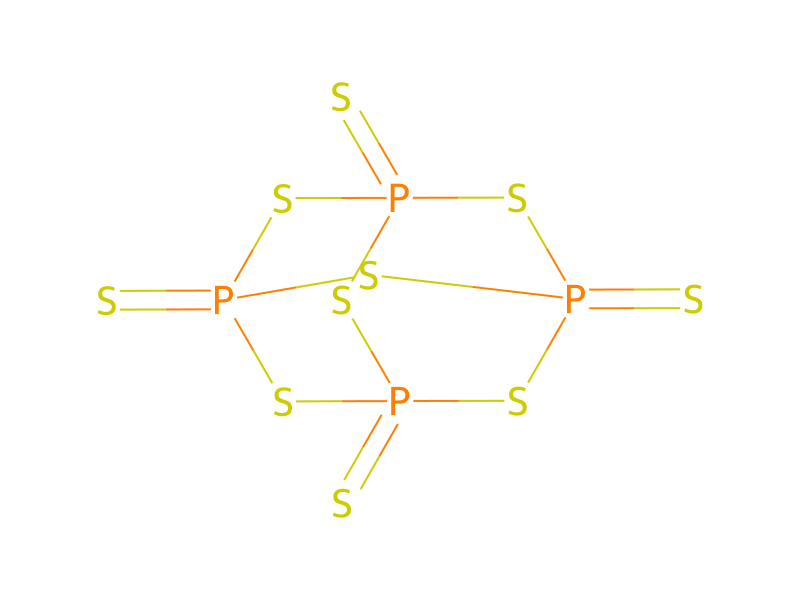

Product 1

Reagents, catalysts & solvents 1

Conditions
- Temperature
- 190 °C
Procedure
The method is derived from the reference H. Davy, Sulfur Letters, vol. 3(2) 39, (1985). P4S10 (44.4 g, 0.1 mol) is mixed with 150 ml of dichlorobenzene until this solvent refluxes (160° C.). Phenylthiol (47 ml) is slowly added to the solution over 90 minutes, while increasing the temperature up to 190° C. The solution becomes clear; the reaction temperature is reduced to 100° C. The stirring is stopped in order to allow the residual P4S10 to be separated by settling. The solution is filtered in the hot state. The product crystallizes after filtration. The yield is 60%.
Workup
- custom(160° C.)
- customis reduced to 100° C
- customto be separated
- filtrationThe solution is filtered in the hot state
- customThe product crystallizes
- filtrationafter filtration
Sources & evidence
- ORD record
- ord-c61f4d2e806d456fbbba2e35c4dfad46
- Source dataset
- uspto-grants-2005_05
- Patent number
- US06890980B2
Reaction notes
Loading…