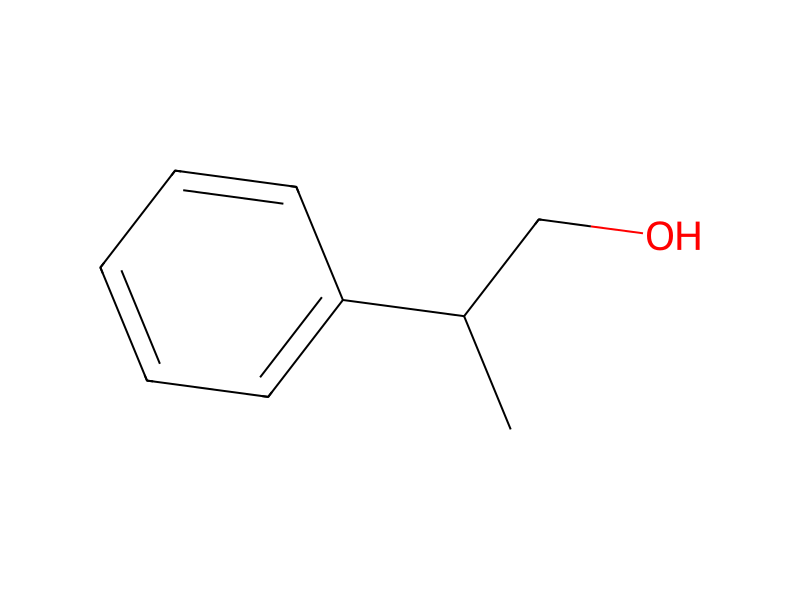
Disiloxane → 2-Phenyl-1-propanol
Reaction equation

[SiH3]O[SiH3].[C:4]1([C@H:10]([CH3:13])[CH2:11][OH:12])[CH:9]=[CH:8][CH:7]=[CH:6][CH:5]=1>>[C:4]1([CH:10]([CH3:13])[CH2:11][OH:12])[CH:9]=[CH:8][CH:7]=[CH:6][CH:5]=1Participants


Procedure
Furthermore, the purificative deprotections of the chiral silylethers (1f and 1m) were examined in the presence of the corresponding enantiomerically pure alcohols using the triphasic system of FIGS. 2 and 3. The deprotection reaction of 1f (1.0 equiv) proceeded in the presence of (R)-(+)-1-(2-naphthyl)ethanol (1.0 equiv), and 1-(2-naphthyl)ethanol was obtained in 83% total yield in a ratio with 41/59 in P-/S-phases (entry 5). The enantiomeric excess (ee) values of 1-(2-naphthyl)ethanol obtained were >97% and 90% in P- and S-phases, respectively. The chiral silyl ether 1m (1.0 equiv) also underwent the purificative deprotection in the presence of (S)-(−)-2-phenylpropanol (1.0 equiv), and 2-phenylpropanol was obtained in 76% total yield in a ratio with 39/61 in P-/S-phases. The ee values of 2-phenylpropanol were 89% and 87% in P- and S-phases, respectively.
Sources & evidence
- ORD record
- ord-34852b41db6d4184b986c6f7f356b45b
- Source dataset
- uspto-grants-2005_05
- Patent number
- US06897331B2
Reaction notes
Loading…