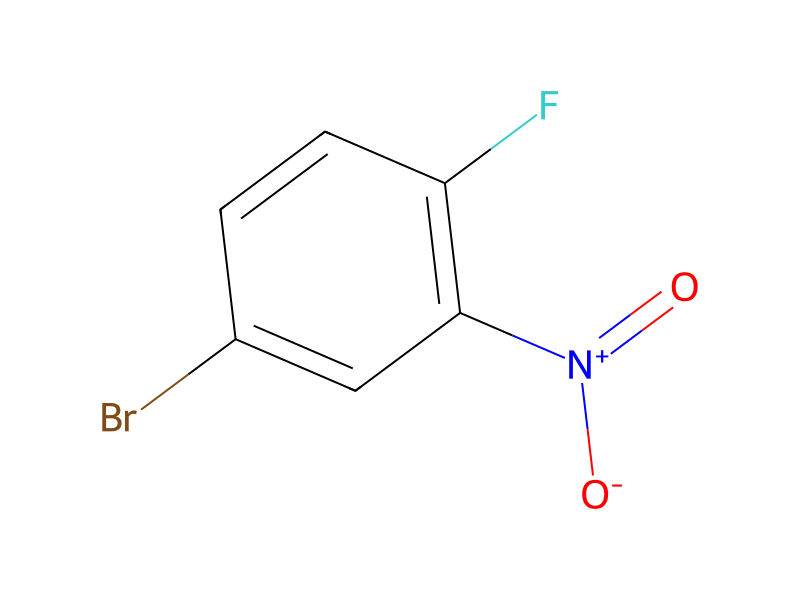
4-Bromo-1-fluoro-2-nitrobenzene → HCID 69708338, compound
Reaction equation

C([Sn](CCCC)(CCCC)[C:6]1[N:10]2[CH:11]=[CH:12][C:13]([C:15]([F:18])([F:17])[F:16])=[N:14][C:9]2=[N:8][CH:7]=1)CCC.Br[C:28]1[CH:29]=[CH:30][C:31]([F:37])=[C:32]([N+:34]([O-:36])=[O:35])[CH:33]=1>O1CCCC1.[Pd].C1(P(C2C=CC=CC=2)C2C=CC=CC=2)C=CC=CC=1.C1(P(C2C=CC=CC=2)C2C=CC=CC=2)C=CC=CC=1.C1(P(C2C=CC=CC=2)C2C=CC=CC=2)C=CC=CC=1.C1(P(C2C=CC=CC=2)C2C=CC=CC=2)C=CC=CC=1>[F:37][C:31]1[CH:30]=[CH:29][C:28]([C:6]2[N:10]3[CH:11]=[CH:12][C:13]([C:15]([F:16])([F:17])[F:18])=[N:14][C:9]3=[N:8][CH:7]=2)=[CH:33][C:32]=1[N+:34]([O-:36])=[O:35]Participants
5




Procedure
To 3-tributylstannyl-7-trifluoromethylimidazo[1,2-α]pyrimidine (73 ml of a 0.13M solution in tetrahydrofuran, 9.44 mmol) was added 5-bromo-2-fluoronitrobenzene (4.20 g, 19 mmol) followed by tetrakis(triphenylphosphine) palladium(0) (0.62 g). The resulting mixture was heated at reflux for 4 h. The solvent was evaporated at reduced pressure and the residue chromatographed on silica gel eluting with 30% ethyl acetate in dichloromethane to afford 3-(4-fluoro-3-nitrophenyl)-7-trifluoromethylimidazo[1,2-α]pyrimidine: δH (400 MHz, DMSO) 7.59 (1H, d, J 7), 7.83 (1H, dd, J 11 and 9), 8.18 (1H, m), 8.36 (1H, s), 8.53 (1H, dd, J 7 and 2), 9.36 (1H, d, J 7); m/z (ES+) 327 (M++H).
Workup
- temperatureThe resulting mixture was heated
- temperatureat reflux for 4 h
- customThe solvent was evaporated at reduced pressure
- customthe residue chromatographed on silica gel eluting with 30% ethyl acetate in dichloromethane
Sources & evidence
- ORD record
- ord-99bb895f8d1c46499060ca1eae0d3515
- Source dataset
- uspto-grants-2005_05
- Patent number
- US06900215B2
Reaction notes
Loading…