Lithium borohydride → Pyrrole
Reaction equation

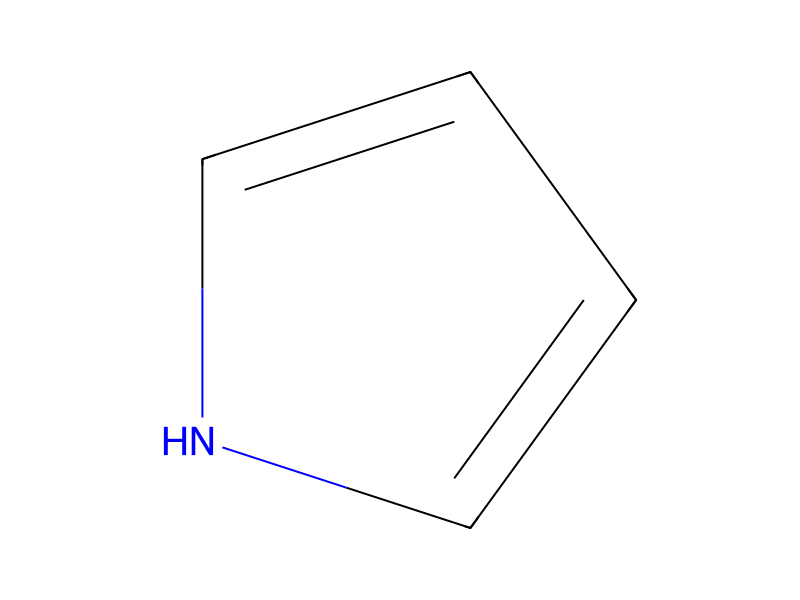
[Li+].[BH4-].[CH3:3][C:4]1[NH:5][CH:6]=[CH:7][C:8]=1C1C=CC(I)=CC=1>>[NH:5]1[CH:6]=[CH:7][CH:8]=[CH:4]1.[CH:8]1[CH:7]=[C:6]([CH2:3][C:4]2[NH:5][CH:6]=[CH:7][CH:8]=2)[NH:5][CH:4]=1Participants



Procedure
The synthesis of the β-substituted EH begins in the same manner as the prior synthesis of β-substituted dipyrromethanes (Balasubramanian, T.; Lindsey, J. S. Tetrahedron 1999, 55, 6771-6784) but employs a number of significant improvements (FIG. 54). The iodophenyl substituted pyrrole (3) is readily prepared from 4-iodobenzaldehyde, monoethyl malonate, and tosylmethylisocyanide. The ethoxycarbonyl group was removed by treatment with NaOH in ethylene glycol at 160° C. to give the 3-(4-iodophenyl)pyrrole (4) in 91% yield as pale brown crystals. It is noteworthy that this single-step decarboxylation is superior to the two-step transformation on similar pyrrole compounds (Pavri, N. R.; Trudell, M. L. J. Org. Chem. 1997, 62, 2649-2651). Vilsmeier-Haack formylation of 4 yielded a mixture of two regioisomers (˜6:1 ratio) which were readily distinguished by 1H NMR spectroscopy (See Experimental Section). The major isomer was the desired compound (5) and was obtained in pure form by recrystallization in 62% yield. Protection of the pyrrolic nitrogen with the BOC group (Tietze, L. F.; Kettschau, G.; Heitmann, K. Synthesis 1996, 851-857) gave pyrrole 6 in quantitative yield. Reduction to alcohol 7 was achieved by treatment with LiBH4 at low temperature (longer reaction time or higher temperature led to the over-reduced and deprotected compound 2-methyl-3-(4-iodophenyl)pyrrole). Treatment of 7 with excess pyrrole under acidic conditions furnished the β-substituted, mono-protected dipyrromethane 8 in 68% yield. Excess pyrrole is necessary to minimize the formation of the tripyrromethane, while protection of the pyrrolic nitrogen is necessary to facilitate the reaction, avoid self condensation and allow the subsequent selective monoacylation. This methodology afforded the β-substituted dipyrromethane as a single regioisomer, in contrast to earlier methodology which gave a mixture of two regioisomers (Balasubramanian, T.; Lindsey, J. S. Tetrahedron 1999, 55, 6771-6784).
Workup
- customlonger reaction time or higher temperature
Sources & evidence
- ORD record
- ord-4bba44d5ca9c430691f6db5a24f15ff5
- Source dataset
- uspto-grants-2002_06
- Patent number
- US06407330B1
Reaction notes
Loading…