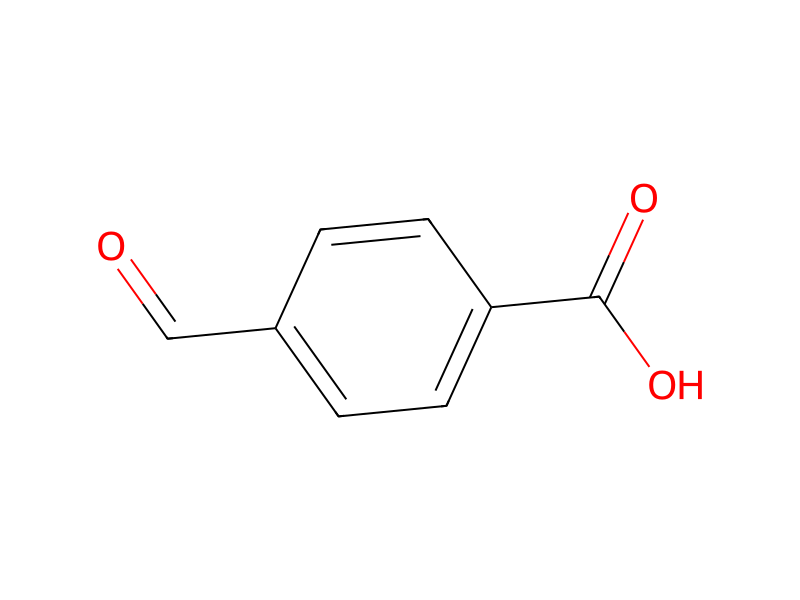
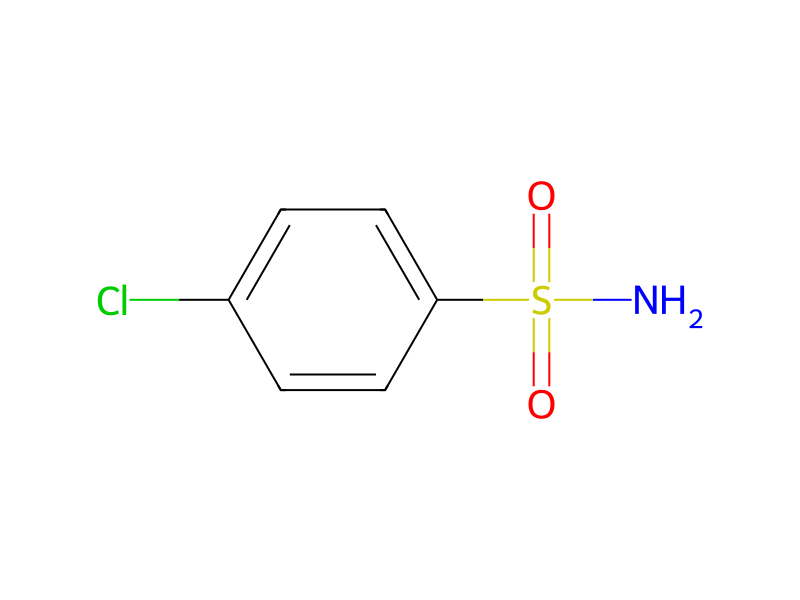
Toluene → 4-{[(4-Chlorobenzene-1-sulfonyl)imino]methyl}benzoic acid
Reaction equation

[C:1]([C:4]1[CH:11]=[CH:10][C:7]([CH:8]=O)=[CH:6][CH:5]=1)([OH:3])=[O:2].[Cl:12][C:13]1[CH:18]=[CH:17][C:16]([S:19]([NH2:22])(=[O:21])=[O:20])=[CH:15][CH:14]=1.C1(C)C=CC=CC=1.C1(C)C=CC(S(O)(=O)=O)=CC=1>O>[Cl:12][C:13]1[CH:14]=[CH:15][C:16]([S:19]([N:22]=[CH:8][C:7]2[CH:10]=[CH:11][C:4]([C:1]([OH:3])=[O:2])=[CH:5][CH:6]=2)(=[O:20])=[O:21])=[CH:17][CH:18]=1Participants
6




Procedure
An equimolar mixture of 25.0 g (0.17 mol) 4-carboxybenzaldehyde and 32.6 g (0.17 mol) 4-chlorobenzenesulfonamide was placed into toluene. 100 mg p-toluenesulfonic acid was added as a catalyst. The mixture was then heated under reflux on a water separator until the theoretically calculated quantity of water had separated. After cooling to room temperature, the precipitated solid was filtered off and dried under vacuum. Yield: 48.3 g (89.4%); 1H-NMR (400 MHz, DMSO-d6): δ [ppm]=7.78 (d, 2H); 8.09 (d, 2H); 8.11 (d, 2H); 8.23 (d, 2H); 9.29 (s, 1H); 13C-NMR (400 MHz, DMSO-d6): δ [ppm]=130.2; 130.5; 131.8; 135.5; 136.0; 136.1; 139.1; 166.6; 171.9; 193.0.
Workup
- temperatureThe mixture was then heated
- customhad separated
- filtrationthe precipitated solid was filtered off
- customdried under vacuum
Sources & evidence
- ORD record
- ord-9e99c24c32bd416f8606c99061275eb3
- Source dataset
- uspto-grants-2012_12
- Patent number
- US08323356B2
Reaction notes
Loading…