2-Bromophenol → 1-Bromo-2-(3-methylbutoxy)benzene
Reaction equation

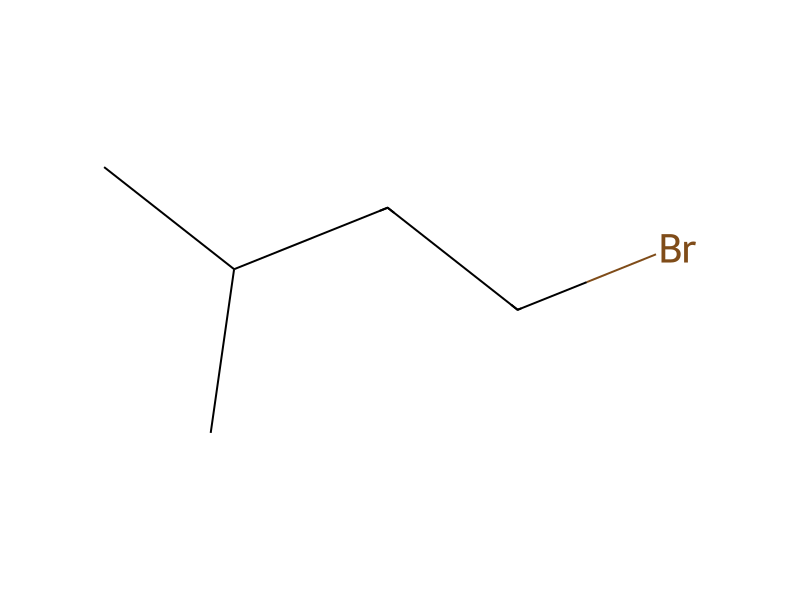
[Br:1][C:2]1[CH:7]=[CH:6][CH:5]=[CH:4][C:3]=1[OH:8].Br[CH2:10][CH2:11][CH:12]([CH3:14])[CH3:13].C(=O)([O-])[O-].[K+].[K+]>CC#N>[Br:1][C:2]1[CH:7]=[CH:6][CH:5]=[CH:4][C:3]=1[O:8][CH2:10][CH2:11][CH:12]([CH3:14])[CH3:13]Participants
5
Reactant 3


Product 1

Reagents, catalysts & solvents 1

Conditions
- Temperature
- 80 °C
Procedure
A round-bottomed flask was charged with commercially available 2-bromophenol (43 g, 0.25 mol), 1-bromo-3-methylbutane (41 mL, 0.33 mol), potassium carbonate (0.38 mol), and 200 mL of CH3CN. The resulting slurry was heated to 80° C. for 18 h. Upon completion, the mixture was cooled down to the room temperature, filtered, and concentrated down under reduced pressure. Vacuum distillation of the residue resulted in 1-bromo-2-(isopentyloxy)benzene (56 g, 93%, b.p. 82° C. at 10 mm Hg) as a colorless liquid. 1H NMR (400 MHz, CDCl3): δ 7.55 (d, 1H), 7.25 (t, 1H), 6.90 (d, 1H), 6.80 (t, 1H), 4.05 (t, 2H), 1.97-1.85 (m, 1H), 1.78-1.70 (m, 2H), 0.98 (d, 6H).
Workup
- temperatureUpon completion, the mixture was cooled down to the room temperature
- filtrationfiltered
- concentrationconcentrated down under reduced pressure
- distillationVacuum distillation of the residue
- customresulted in 1-bromo-2-(isopentyloxy)benzene (56 g, 93%, b.p. 82° C. at 10 mm Hg) as a colorless liquid
Sources & evidence
- ORD record
- ord-b9251274e5354baa809687f9db7eebb8
- Source dataset
- uspto-grants-2012_12
- Patent number
- US08324231B2
Reaction notes
Loading…