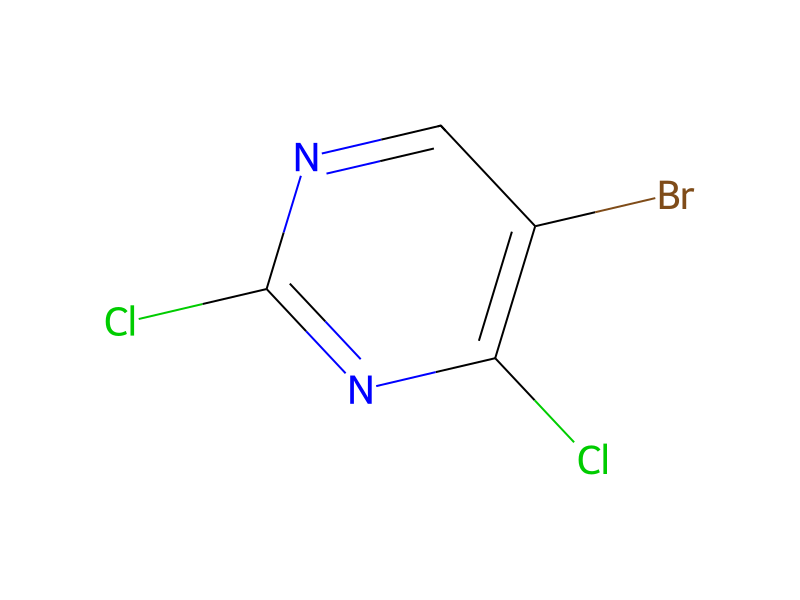
5-Bromo-2,4-dichloropyrimidine → Tert-butyl 4-((5-bromo-2-chloropyrimidin-4-yloxy)methyl)piperidine-1-carboxylate
Reaction equation

[Br:1][C:2]1[C:3](Cl)=[N:4][C:5]([Cl:8])=[N:6][CH:7]=1.[OH:10][CH2:11][CH:12]1[CH2:17][CH2:16][N:15]([C:18]([O:20][C:21]([CH3:24])([CH3:23])[CH3:22])=[O:19])[CH2:14][CH2:13]1>>[Br:1][C:2]1[C:3]([O:10][CH2:11][CH:12]2[CH2:17][CH2:16][N:15]([C:18]([O:20][C:21]([CH3:24])([CH3:23])[CH3:22])=[O:19])[CH2:14][CH2:13]2)=[N:4][C:5]([Cl:8])=[N:6][CH:7]=1Participants
3


Procedure
Using the procedure of Example 1 Step 1, 5-bromo-2,4-dichloropyrimidine was reacted with tert-butyl 4-(hydroxymethyl)piperidine-1-carboxylate to provide the title compound in 63% yield. 1H NMR (CDCl3, 400 MHz) 8.43 (s, 1H), 4.32 (d, 2H), 4.18 (m, 2H), 2.76 (m, 2H), 2.03 9 m, 1H), 1.80 (m, 2H), 1.46 (s, 9H), 1.34-1.26 (m, 2H); MS (ESI) m/z: Calc: 405.1 (M+). Found. 307.9 (M+-Boc+2).
Sources & evidence
- ORD record
- ord-6bb65e59fc3e41d4afc81664557019bf
- Source dataset
- uspto-grants-2012_12
- Patent number
- US08334292B1
Reaction notes
Loading…