1,2-Diethylhydrazine dihydrochloride → HCID 10442180, compound
Reaction equation
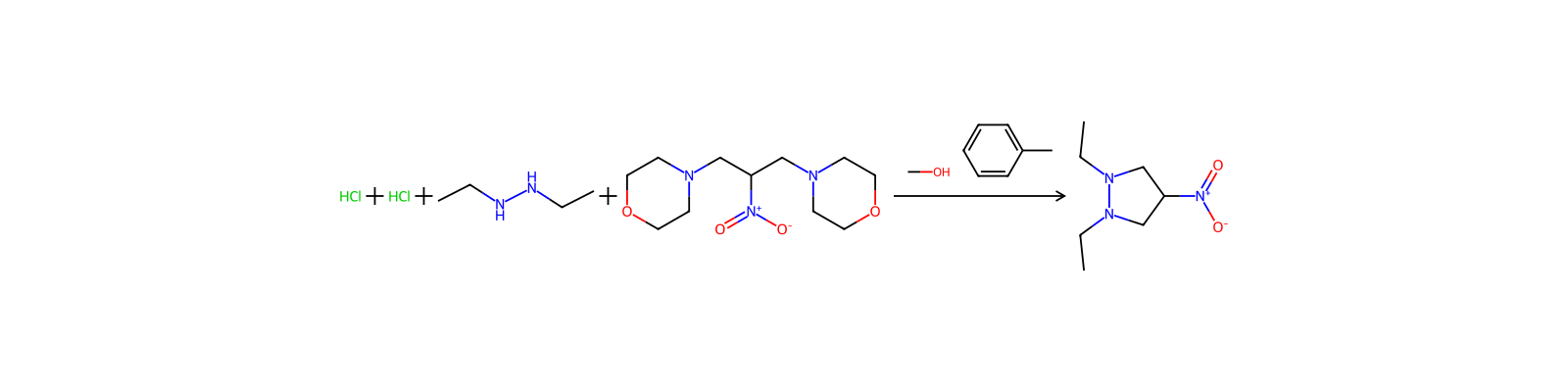
Cl.Cl.C(NNCC)C.O1CC[N:12]([CH2:15][CH:16]([N+:24]([O-:26])=[O:25])[CH2:17][N:18]2CCO[CH2:20][CH2:19]2)[CH2:11][CH2:10]1>CO.C1(C)C=CC=CC=1>[N+:24]([CH:16]1[CH2:15][N:12]([CH2:11][CH3:10])[N:18]([CH2:19][CH3:20])[CH2:17]1)([O-:26])=[O:25]Participants
Reactant 2


Product 1

Reagents, catalysts & solvents 2


Procedure
A stirred solution of 4.03 g. (0.025 moles) of 1,2-diethyl hydrazine dihydrochloride and 6.72 g. (0.026 moles) of 1,3-dimorpholino-2-nitropropane in a mixture of 28 ml of methanol and 16 ml of toluene was heated at reflux for 3 hours. The solvents were evaporated under reduced pressure and the residue was re-suspended in toluene. The solid (mostly morpholine hydrochloride) was removed by filtration, leaving a solution of the title compound in toluene. Evaporation of the toluene gave an oil weighing 5.1 g., the free base of the title compound with minor impurity. Column chromatography on Florisil, eluting with toluene, gave pure title compound which was obtained as an oil by evaporation of toluene under reduced pressure. The product was characterized as follows: Infra Red (CHCl3, microns) 6.46 (S), 6.94 (M), 7.27 (S) and 9.82 (M); Nuclear Magnetic Resonance (CDCL3, δ)=5.18 (m, 1H), 3.16-3.75 with weight center at 3.47 (m, 4H), 2.56 (q, 7.7HZ, 4H), 1.07 (t, 7.7 HZ, 6H); Mass Spec: M+ 173.
Workup
- temperaturewas heated
- temperatureat reflux for 3 hours
- customThe solvents were evaporated under reduced pressure
- customThe solid (mostly morpholine hydrochloride) was removed by filtration
Sources & evidence
- ORD record
- ord-b840c81fcb804a0581a5f2b269014839
- Source dataset
- uspto-grants-1982_11
- Patent number
- US04358599
Reaction notes
Loading…