3,5-Dichloroaniline → HCID 178431743, compound
Reaction equation

[CH3:1][C:2]12[C:9](=[O:10])[O:8][C:6](=[O:7])[CH:3]1[CH2:4][CH2:5]2.[Cl:11][C:12]1[CH:13]=[C:14]([CH:16]=[C:17]([Cl:19])[CH:18]=1)[NH2:15]>C1(C)C=CC=CC=1>[Cl:11][C:12]1[CH:13]=[C:14]([N:15]=[C:9]([C:2]2([CH3:1])[CH2:5][CH2:4][CH:3]2[C:6]([OH:8])=[O:7])[OH:10])[CH:16]=[C:17]([Cl:19])[CH:18]=1Participants
Reactant 2
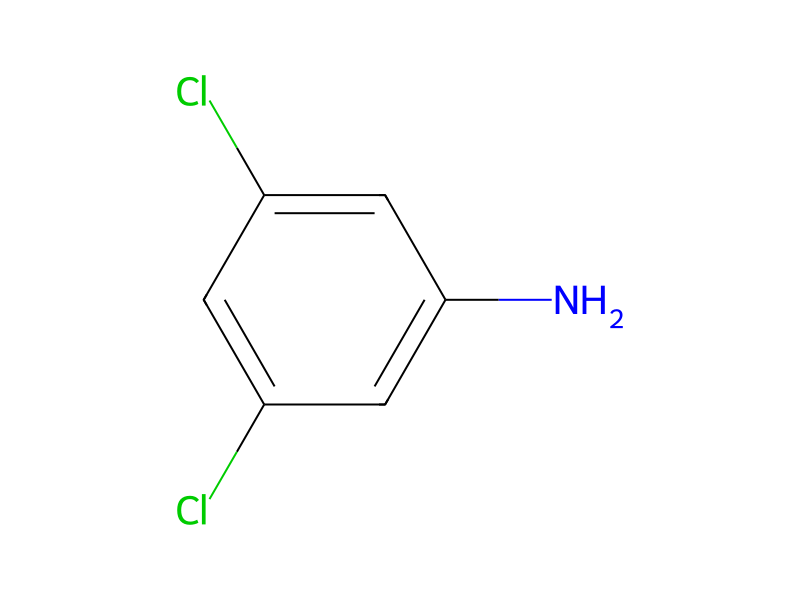

Product 1

Reagents, catalysts & solvents 1

Procedure
10 g (0.07 mol) of 1-methyl-cyclobutane-1,2-dicarboxylic acid anhydride are dissolved in 50 ml of toluene, and 11.6 g (0.07 mol) of 3,5-dichloroaniline are added. After 24 hours' stirring at room temperature, the amide acid (m.p. 106°-108° C.) which has precipitated is separated. This amidocarboxylic acid is suspended in 40 ml of acetic anhydride, and the suspension is stirred for 24 hours at room temperature, in the course of which everything goes into solution. The acetic anhydride is evaporated off in a water-jet vacuum, and the pulverulent residue is recrystallised from dichloromethane/n-hexane to yield 15 g (73% of theory) of 1-methyl-cyclobutane-1,2-dicarboxylic acid-(3,5-dichlorophenyl)-imide, m.p. 110°-111° C. NMR Spectrum (100 MHz) δ in ppm: 1.55 (s,3H, CH3), 2.0-3.2 (m, 5H, --CH2CH2 --CH--), 7.2-7.5 (m, 3H, aromat.). Compound No. 7.
Workup
- customthe amide acid (m.p. 106°-108° C.) which has precipitated
- customis separated
- stirringthe suspension is stirred for 24 hours at room temperature, in the course of which everything
- customThe acetic anhydride is evaporated off in a water-jet vacuum
- customthe pulverulent residue is recrystallised from dichloromethane/n-hexane
Sources & evidence
- ORD record
- ord-a583e44f414e46b983506d0ce579163e
- Source dataset
- uspto-grants-1982_11
- Patent number
- US04361576
Reaction notes
Loading…