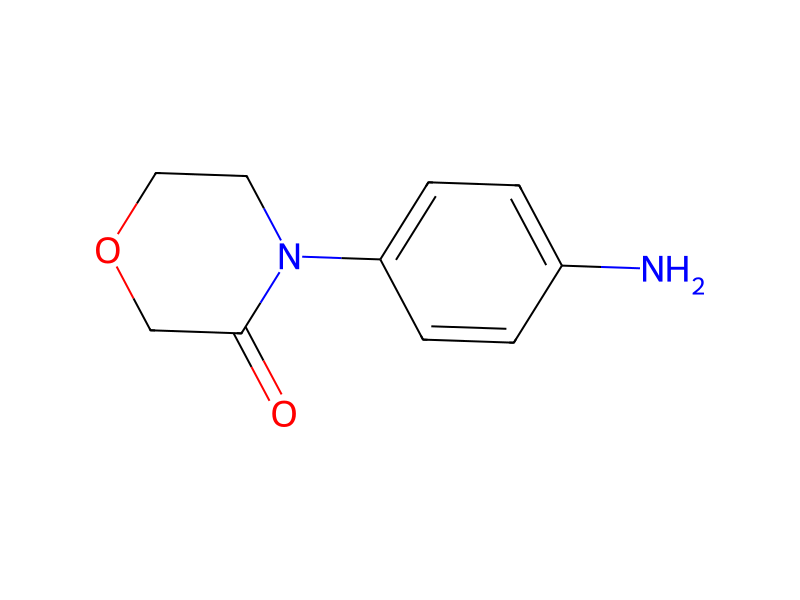
(S)-(+)-N-(2,3-Epoxypropyl)phthalimide → 2-((2R)-2-hydroxy-3-((4-(3-oxomorpholin-4-yl)phenyl)amino)propyl)-1H-isoindole-1,3(2H)-dione
Reaction equation

C1C(N2C(=O)COCC2)=CC=C(N2C(=O)O[C@@H](CNC(C3SC(Cl)=CC=3)=O)C2)C=1.[NH2:30][C:31]1[CH:36]=[CH:35][C:34]([N:37]2[CH2:42][CH2:41][O:40][CH2:39][C:38]2=[O:43])=[CH:33][CH:32]=1.[O:44]1[CH2:46][C@@H:45]1[CH2:47][N:48]1[C:56](=[O:57])[C:55]2[C:50](=[CH:51][CH:52]=[CH:53][CH:54]=2)[C:49]1=[O:58]>>[OH:44][C@H:45]([CH2:46][NH:30][C:31]1[CH:32]=[CH:33][C:34]([N:37]2[CH2:42][CH2:41][O:40][CH2:39][C:38]2=[O:43])=[CH:35][CH:36]=1)[CH2:47][N:48]1[C:49](=[O:58])[C:50]2[C:55](=[CH:54][CH:53]=[CH:52][CH:51]=2)[C:56]1=[O:57]Participants



Procedure
WO 01/47919, application disclosed the Rivaroxaban with applications for prevention and treatment of various thromboembolic diseases. Further this patent describes a method for preparation of Rivaroxaban of formula (I), wherein 4-(4-aminophenyl)morpholin-3-one is reacted with 2-[(2S)-oxiran-2-ylmethyl]-1H-isoindole-1,3(2H)-dione, in presence of solvent to obtain 2-[(2R)-2-hydroxy-3-{[4(3-oxomorpholin-4-yl)phenyl]amino}propyl]-1H-isoindole-1,3(2H)-dione which is further converted to 2-({(5S)-2-oxo-3-[4-(3-oxomorpholin-4-yl)phenyl]-1,3-oxazolidin-5-yl}methyl)-1H-isoindole-1,3(2H)-dione by phosgene equivalent. Departing of the pthalamide group affords 4-{4-[(5S)-5-(aminomethyl)-2-oxo-1,3-oxazolidin-3-yl]phenyl}morpholin-3-one, which is finally coupled with 5-chlorothiophene-2-carbonyl chloride to give 5-chloro-N-({(5S)-2-oxo-3-[4-(3-oxomorpholin-4-yl)phenyl]-1,3-oxazolidin-5-yl}methyl)thiophene-2-carboxamide i.e. Rivaroxaban of formula (I) as shown in scheme-1;
Sources & evidence
- ORD record
- ord-a3b23236182049f8a10c31466bd0109f
- Source dataset
- uspto-grants-2016_06
- Patent number
- US09359341B2
Reaction notes
Loading…