Acetone → Sucrose
Reaction equation

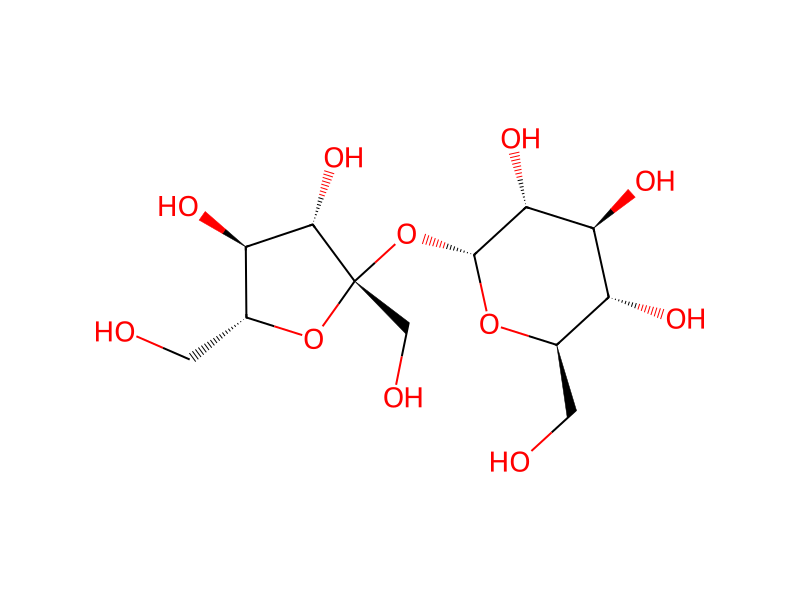
[CH2:1]([OH:23])[C@H:2]1[O:7][C@H:6]([O:8][C@:9]2([CH2:18][OH:19])[O:13][C@H:12]([CH2:14][OH:15])[C@@H:11]([OH:16])[C@@H:10]2[OH:17])[C@H:5]([OH:20])[C@@H:4]([OH:21])[C@@H:3]1[OH:22].[CH3:24]C(C)=O>>[CH2:1]([OH:23])[C@H:2]1[O:7][C@H:6]([O:8][C@:9]2([CH2:18][OH:19])[O:13][C@H:12]([CH2:14][OH:15])[C@@H:11]([OH:16])[C@@H:10]2[OH:17])[C@H:5]([OH:20])[C@@H:4]([OH:21])[C@@H:3]1[OH:22].[C:6]([O:8][C:9]([CH3:10])([CH3:18])[CH3:24])(=[O:7])[CH2:5][C:4]([CH3:3])=[O:21]Participants


Procedure
Sucrose and glycerin acetoacetates were prepared using 2,2,6-trimethyl-4H-1,3-dioxan-4-one (structure below) as a starting material. A 2 L flask equipped with a Dean-Stark trap, reflux condenser and thermometer, was charged with 100.3 g of sucrose and 335 g of 2,2,6-trimethyl-4H-1,3-dioxan-4-one (TDO). The reaction mixture was brought to 96° C. at which point the evolution of acetone commenced. Acetone was collected over the next 1.5 hours until distillation stopped. The quantity of acetone collected showed that ˜98 mol % of the available hydroxyl groups had reacted. The product was then tested as per the material obtained from the t-butyl acetoacetate synthesis. It per formed the same according to the previous Examples. This synthetic route provides for synthesis of the product at lower temperature and at higher conversion levels.
Workup
- customA 2 L flask equipped with a Dean-Stark trap
- temperaturereflux condenser
- customwas brought to 96° C. at which
- distillationAcetone was collected over the next 1.5 hours until distillation
- customThe quantity of acetone collected
- customhad reacted
Sources & evidence
- ORD record
- ord-5fb93b34570c48d9ae6a904a7655c54e
- Source dataset
- uspto-grants-2016_06
- Patent number
- US09359471B2
Reaction notes
Loading…