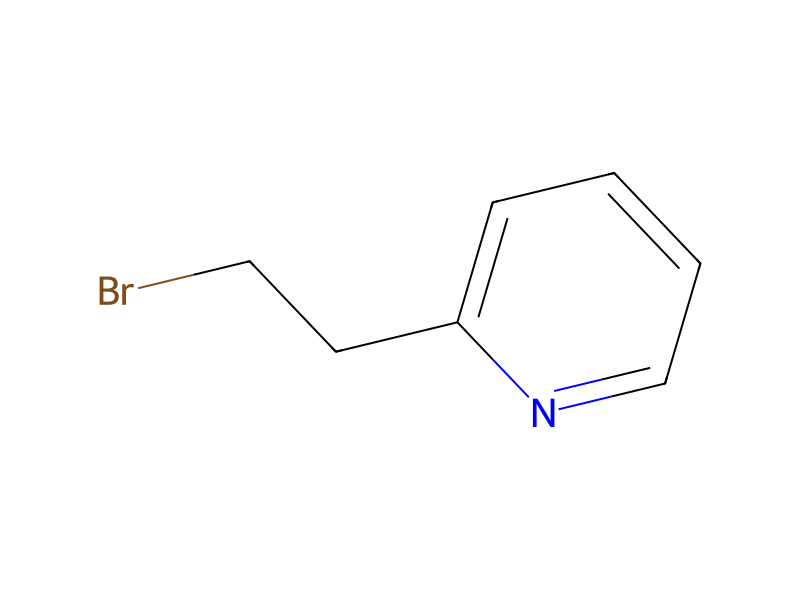
2-(2-Bromoethyl)pyridine → HCID 68212661, compound
Reaction equation

[Cl:1][C:2]1[CH:7]=[CH:6][C:5]([C:8]2[CH:12]=[C:11]([CH:13]3[CH2:18][CH2:17][NH:16][CH2:15][CH2:14]3)[N:10]([C:19]3[CH:24]=[CH:23][CH:22]=[CH:21][CH:20]=3)[N:9]=2)=[CH:4][CH:3]=1.Br[CH2:26][CH2:27][C:28]1[CH:33]=[CH:32][CH:31]=[CH:30][N:29]=1>ClCCl.CCOC(C)=O>[Cl:1][C:2]1[CH:3]=[CH:4][C:5]([C:8]2[CH:12]=[C:11]([CH:13]3[CH2:18][CH2:17][N:16]([CH2:26][CH2:27][C:28]4[CH:33]=[CH:32][CH:31]=[CH:30][N:29]=4)[CH2:15][CH2:14]3)[N:10]([C:19]3[CH:20]=[CH:21][CH:22]=[CH:23][CH:24]=3)[N:9]=2)=[CH:6][CH:7]=1Participants
5
Reactant 2

Product 1

Reagents, catalysts & solvents 2


Conditions
- Temperature
- 60 °C
Procedure
To a solution of INTERMEDIATE 5 (30 mg, 0.089 mmol) in dichloromethane (0.4 mL) was added 2-(2-bromoethyl)pyridine (28.4, 0.107 mmol). The mixture was stirred at 60° C. overnight, and then cooled to room temperature. The mixture was diluted with EtOAc, and washed with water. The organic layer was separated, dried and concentrated. The resulting residue was purified by preparative TLC (using 2 M NH3 in MeOH/MeOH/DCM/0.05 mL/5 mL/9.5 mL) to give the title compound. LC-MS m/z 443.17 [M+H]+.
Workup
- temperaturecooled to room temperature
- washwashed with water
- customThe organic layer was separated
- customdried
- concentrationconcentrated
- customThe resulting residue was purified by preparative TLC (using 2 M NH3 in MeOH/MeOH/DCM/0.05 mL/5 mL/9.5 mL)
Sources & evidence
- ORD record
- ord-548575cb3a634c118f9d8ec204630b3b
- Source dataset
- uspto-grants-2016_06
- Patent number
- US09365539B2
Reaction notes
Loading…