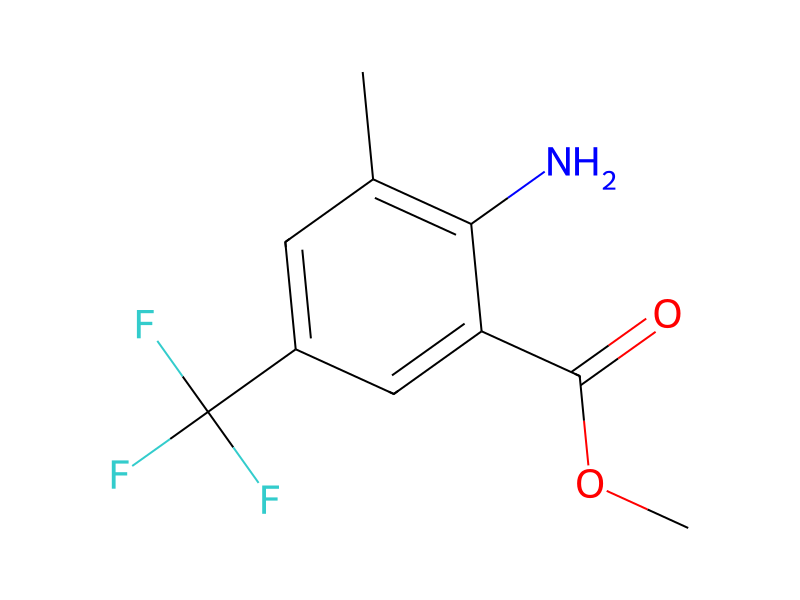
Cesium carbonate → Methyl 2-amino-3-methyl-5-(trifluoromethyl)benzoate
Reaction equation

[NH2:1][C:2]1[C:11](I)=[CH:10][C:9]([C:13]([F:16])([F:15])[F:14])=[CH:8][C:3]=1[C:4]([O:6][CH3:7])=[O:5].[CH3:17]B1OB(C)OB(C)O1.C(=O)([O-])[O-].[Cs+].[Cs+]>O1CCOCC1>[NH2:1][C:2]1[C:11]([CH3:17])=[CH:10][C:9]([C:13]([F:16])([F:15])[F:14])=[CH:8][C:3]=1[C:4]([O:6][CH3:7])=[O:5]Participants
5




Conditions
- Temperature
- 130 °C
Procedure
A mixture of methyl 2-amino-3-iodo-5-(trifluoromethyl)benzoate (0.633 g, 1.83 mmoles), trimethylboroxine (0.56 ml, 3.66 mmoles), cesium carbonate (1.2 g, 3.66 mmoles) and 1,1′-bis(diphenylphosphino)ferrocene-palladium(II) dichloride dichloromethane complex (0.075 g, 0.09 mmoles) in 1,4-dioxane (15 mL) was heated in a microwave reactor at 130° C. for 1.5 h. The mixture was partitioned between water (30 ml) and ethyl acetate (2×30 ml). The combined organics were dried over sodium sulphate, filtered and evaporated to dryness. The residue was chromatographed on silica gel eluting with an ethyl acetate/isohexane gradient. This gave the title compound 3 as an orange solid (0.41 g, 96%).
Workup
- customThe mixture was partitioned between water (30 ml) and ethyl acetate (2×30 ml)
- dry with materialThe combined organics were dried over sodium sulphate
- filtrationfiltered
- customevaporated to dryness
- customThe residue was chromatographed on silica gel eluting with an ethyl acetate/isohexane gradient
Sources & evidence
- ORD record
- ord-b6cd06d9c0974345abc07764d824ba3d
- Source dataset
- uspto-grants-2016_06
- Patent number
- US09365569B2
Reaction notes
Loading…