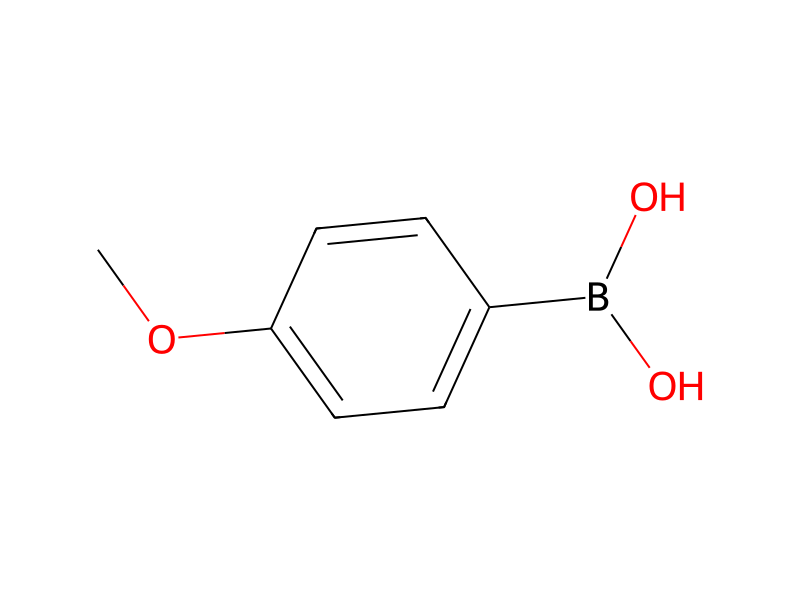
(4-Methoxyphenyl)boronic acid → HCID 86718115, compound
Reaction equation

Cl[C:2]1[C:3]([C:16]2[CH:21]=[CH:20][CH:19]=[CH:18][CH:17]=2)=[N:4][C:5]2[C:10]([N:11]=1)=[CH:9][C:8]([C:12]([O:14]C)=[O:13])=[CH:7][CH:6]=2.[CH3:22][O:23][C:24]1[CH:29]=[CH:28][C:27](B(O)O)=[CH:26][CH:25]=1>>[CH3:22][O:23][C:24]1[CH:29]=[CH:28][C:27]([C:2]2[C:3]([C:16]3[CH:17]=[CH:18][CH:19]=[CH:20][CH:21]=3)=[N:4][C:5]3[C:10]([N:11]=2)=[CH:9][C:8]([C:12]([OH:14])=[O:13])=[CH:7][CH:6]=3)=[CH:26][CH:25]=1Participants
3


Procedure
The product was obtained via a Suzuki coupling reaction using the method previously shown in Example 20, Step 3, with methyl 3-chloro-2-phenylquinoxaline-6-carboxylate (50 mg, 0.17 mmol, 1.00 equiv) and 4-methoxyphenylboronic acid (38 mg, 0.25 mmol, 1.50 equiv) as reactants. Purification via Prep-TLC (silica gel) yielded 25 mg (42%) of 3-(4-methoxyphenyl)-2-phenylquinoxaline-6-carboxylic acid as a yellow solid.
Workup
- customThe product was obtained via a Suzuki coupling reaction
- customPurification via Prep-TLC (silica gel)
Sources & evidence
- ORD record
- ord-1180aa53023444fc95dc1a46bf11f003
- Source dataset
- uspto-grants-2016_06
- Patent number
- US09370522B2
Reaction notes
Loading…