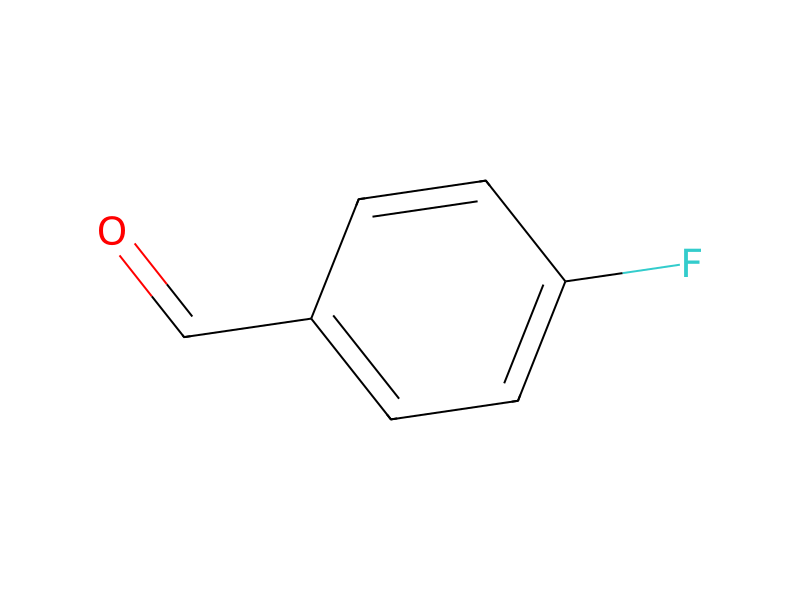
4-Fluorobenzaldehyde → N-[(4-fluorophenyl)methylidene]hydroxylamine
Reaction equation

[F:1][C:2]1[CH:9]=[CH:8][C:5]([CH:6]=O)=[CH:4][CH:3]=1.Cl.[NH2:11][OH:12]>>[F:1][C:2]1[CH:9]=[CH:8][C:5]([CH:6]=[N:11][OH:12])=[CH:4][CH:3]=1Participants
3


Procedure
In another embodiment, 1-(3-(4-fluorophenyl)-isoxazol-5-yl)ethanol and 1-(3-(4-fluorophenyl)-isoxazol-5-yl) ethanone may be produced as described in Scheme 12A. 4-Fluoro-benzaldehyde is reacted with hydroxylamine hydrochloride to provide 4-fluorobenzaldehyde oxime. The isoxazole ring is then generated by reacting this intermediate with but-3-yn-2-ol and NCS to provide 1-(3-(4-fluorophenyl)isoxazol-5-yl) ethanol. 1-(3-(4-Fluorophenyl)isoxazol-5-yl)ethanol is then oxidized to the ketone, i.e., 1-(3-(4-fluorophenyl)-isoxazol-5-yl)ethanone, which may then be converted to a compound of formula (I-A) by the methods described herein.
Sources & evidence
- ORD record
- ord-55406b3b2ec143178477089bcf6dcedb
- Source dataset
- uspto-grants-2016_06
- Patent number
- US09371316B2
Reaction notes
Loading…