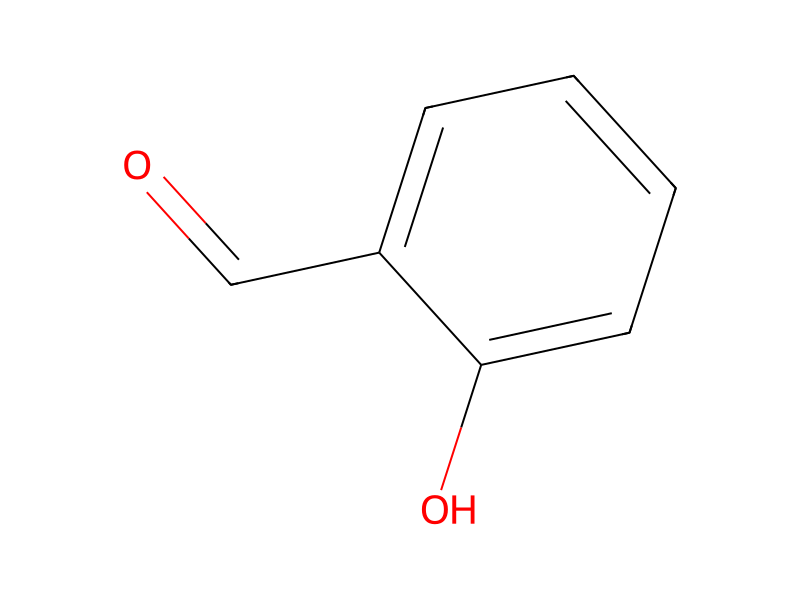
Salicylaldehyde → HCID 802757, compound
Reaction equation

Cl[C:2]1[CH:7]=[CH:6][C:5]([C:8]([F:11])([F:10])[F:9])=[CH:4][C:3]=1[N+:12]([O-:14])=[O:13].[K].[CH:16](=[O:24])[C:17]1[C:18](=[CH:20][CH:21]=[CH:22][CH:23]=1)[OH:19]>O>[N+:12]([C:3]1[CH:4]=[C:5]([C:8]([F:11])([F:10])[F:9])[CH:6]=[CH:7][C:2]=1[O:19][C:18]1[CH:20]=[CH:21][CH:22]=[CH:23][C:17]=1[CH:16]=[O:24])([O-:14])=[O:13]Participants
Reactant 3


Product 1

Reagents, catalysts & solvents 1

Conditions
- Temperature
- 150 °C
Procedure
200 parts of 4-chloro-3-nitrobenzotrifluoride was heated to 160° C. and stirred and 160 parts of the potassium salt of salicylaldehyde was added over a period of 30 minutes. After the addition was complete, an exothermic reaction took place and the temperature rose to about 195° C. Heating was then discontinued until the reaction subsided, and the mixture was then heated for 1 hour at 150° C. The mixture was cooled, ice and water were added, and it was then extracted with ether. The ether layer was filtered to remove insoluble material, and the resultant solution was dried over sodium sulfate. The ether solvent was then evaporated and the residual oil was recrystallized from a mixture of hexane and benzene to give 2-(2-nitro-4-trifluoromethylphenoxy)benzaldehyde melting at about 79°-81° C.
Workup
- additionAfter the addition
- customan exothermic reaction
- customrose to about 195° C
- temperatureHeating
- temperatureThe mixture was cooled
- extractionit was then extracted with ether
- filtrationThe ether layer was filtered
- customto remove insoluble material
- dry with materialthe resultant solution was dried over sodium sulfate
- customThe ether solvent was then evaporated
- customthe residual oil was recrystallized from a mixture of hexane and benzene
Sources & evidence
- ORD record
- ord-7904236e038545c4aa1a0de927fae5ef
- Source dataset
- uspto-grants-1995_10
- Patent number
- US05461046
Reaction notes
Loading…