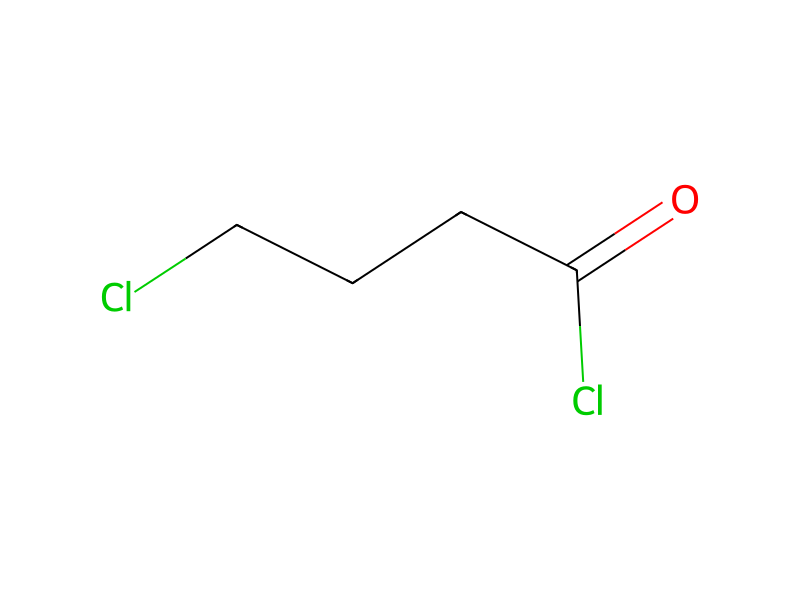
4-Chlorobutyryl chloride → HCID 15292528, compound
Reaction equation

[C:1]([N:4]1[CH2:10][CH2:9][C:8]2[CH:11]=[CH:12][CH:13]=[CH:14][C:7]=2[CH2:6][CH2:5]1)(=[O:3])[CH3:2].[Cl:15][CH2:16][CH2:17][CH2:18][C:19](Cl)=[O:20].[Cl-].[Al+3].[Cl-].[Cl-]>ClCCl>[Cl:15][CH2:16][CH2:17][CH2:18][C:19]([C:12]1[CH:13]=[CH:14][C:7]2[CH2:6][CH2:5][N:4]([C:1](=[O:3])[CH3:2])[CH2:10][CH2:9][C:8]=2[CH:11]=1)=[O:20]Participants
Reactant 3


Product 1

Reagents, catalysts & solvents 1

Conditions
- Temperature
- 20 °C
Procedure
In 30 ml of dichloromethane, was dissolved 3.79 g of 3-acetyl-2,3,4,5-tetrahydro-1H-3-benzazepine. To the solution were added 3.38 g of 4-chlorobutyryl chloride and 4.00 g of aluminum chloride. The mixture was stirred for 2 hours at room temperature (about 20° C.). The reaction mixture was poured into 50 ml of ice-water. The organic layer was separated, which was washed successively with 50 ml of 0.5N aqueous solution of sodium hydroxide and 50 ml of pure water, then dried over anhydrous sodium sulfate. The solvent was distilled off to leave 5.40 g of an oily residue. The residue was purified by means of a silica gel column chromatography (developing solvent, ethyl acetate-dichloromethane 1:1 (V/V)) to afford 2.92 g of the title compound as colorless crystals, m.p.103°-106° C.
Workup
- customThe organic layer was separated
- washwhich was washed successively with 50 ml of 0.5N aqueous solution of sodium hydroxide and 50 ml of pure water
- dry with materialdried over anhydrous sodium sulfate
- distillationThe solvent was distilled off
Sources & evidence
- ORD record
- ord-ac4ffbf5f00a44ebbdb8ca4507ca6e45
- Source dataset
- uspto-grants-1995_10
- Patent number
- US05462934
Reaction notes
Loading…