Benzonitrile → Diphenylacetylene
Reaction equation

[C:1]1([C:7]#[CH:8])[CH:6]=[CH:5][CH:4]=[CH:3][CH:2]=1.C([Li])CCC.C(#N)[C:15]1[CH:20]=[CH:19][CH:18]=[CH:17][CH:16]=1.CP(C)C.CCCCCCCCCCCCC>C1COCC1.[Zn+2].[Br-].[Br-]>[C:1]1([C:7]#[C:8][C:15]2[CH:20]=[CH:19][CH:18]=[CH:17][CH:16]=2)[CH:6]=[CH:5][CH:4]=[CH:3][CH:2]=1Participants
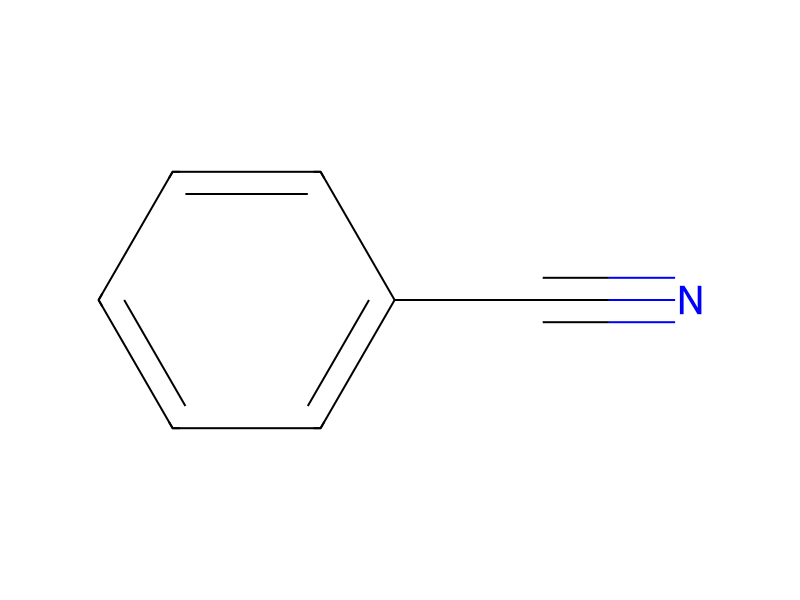






Procedure
A solution of phenylacetylene (0.439 ml; 0.409 g; 4.00 mmol) in THF (2 ml) was treated at 0° C. with n-butyllithium (1.6 ml; 4.0 mmol; 2.5 M in hexanes) and the resulting solution was allowed to warm to room temperature for 10 min. The solution was cooled to 0° C., then treated with a solution of ZnBr2 (0.901 g; 4.00 mmol) in THF (2 ml) and allowed to warm to room temperature for 30 min. Solvent was removed in vacuo, then THF (2 ml) was added. This solution was then added to a room temperature solution of benzonitrile (0.204 ml; 0.206 g; 2.00 mmol), dichlorobis(trimethylphosphine)nickel (0.0282 g; 5 mol %), trimethylphosphine (0.20 ml; 0.20 mmol; 1.0 M in THF), and tridecane (0.244 ml; 0.184 g; 1.00 mmol) in THF (2 ml). The reaction mixture was then heated to 65° C. and stirred for 44 h; then a sample was withdrawn and quenched in a mixture of 1 M sodium citrate (aq) and MTBE. GC analysis of the organic phase of the hydrolyzed reaction sample showed the presence of 1.43 mmol (72% yield) of diphenylacetylene and 0.36 mmol of benzonitrile remaining in the reaction mixture.
Workup
- temperatureThe solution was cooled to 0° C.
- temperatureto warm to room temperature for 30 min
- customSolvent was removed in vacuo
- additionTHF (2 ml) was added
- temperatureThe reaction mixture was then heated to 65° C.
- customthen a sample was withdrawn
- customquenched in a mixture of 1 M sodium citrate (aq) and MTBE
Sources & evidence
- ORD record
- ord-6f02debe8b59483386212d73f863b302
- Source dataset
- uspto-grants-2006_09
- Patent number
- US07105707B2
Reaction notes
Loading…