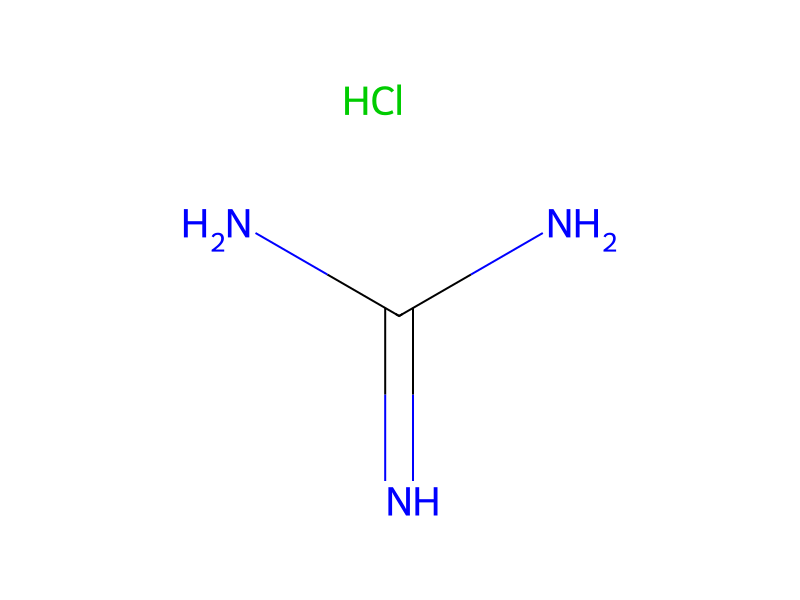
Guanidine Hydrochloride → HCID 178473939, compound
Reaction equation

[N:1]1([C:12](=[O:13])[C:11]2[N:10]([CH2:14][C:15](O)=O)[CH:9]=[N:8][C:7]=2[N:5]([CH3:6])[C:3]1=[O:4])[CH3:2].S(Cl)(Cl)=O.Cl.[NH2:23][C:24]([NH2:26])=[NH:25].[OH-:27].[Na+]>>[NH:25]([CH2:2][N:1]1[C:12](=[O:13])[C:11]2[N:10]([C:14](=[O:27])[CH3:15])[CH:9]=[N:8][C:7]=2[N:5]([CH3:6])[C:3]1=[O:4])[C:24]([NH2:26])=[NH:23]Participants
5




Conditions
- Temperature
- 45 °C
Procedure
Theophylline-7-acetic acid (TAA) (0.42 moles, 100 grams) is admixed with excess thionyl chloride (SOC12) and slowly heated to 45° C. and refluxed for 2 hours. When reaction is completed, the excess SOC12 is removed under vacuum evaporation at 50° C., in the presence of benzene (80 grams). The vacuum evaporation with benzene is repeated three times to eliminate all residual SOC12. The resultant compound, theophylline-7-acetyl chloride (“TAC”) is added to a solution of guanidine hydrochloride (0.25 mols, 60 grams) and 5 equivalents of 2 normal sodium hydroxide at 0° C.
Workup
- temperaturerefluxed for 2 hours
- customWhen reaction
- customthe excess SOC12 is removed under vacuum evaporation at 50° C., in the presence of benzene (80 grams)
- customThe vacuum evaporation with benzene
Sources & evidence
- ORD record
- ord-226a71ac798e41ce9f7cdedbc0bb4c70
- Source dataset
- uspto-grants-2006_09
- Patent number
- US07109329B2
Reaction notes
Loading…